Whether you’re a commercial transporter or a producer transporting your own animals, it is important to keep records on the movement of animals to ensure that animals are being responsibly taken care of and humanely transported. You can do this by filling out a Transfer of Care form and an Animal Transport Record. But what’s the difference? Transfer of Care Form What is its purpose? The purpose of a Transfer of Care Form is to ensure that animals are not left at slaughter facilities, assembly centres, or auctions without evidence that the care has been transferred from the transporter to the receiver. This form only applies for animals that are delivered to slaughter, assembly, and auction facilities. After the recipient…
All posts tagged Sheep
Artificial Lamb Rearing: Part 1 – A Producer Project
From March to August 2022 an on-farm project on artificial rearing systems specifically focusing on milk machines and lamb performance was conducted at several Ontario farms. The project had three main objectives: lamb productivity, rearing cost, and producer labour. The results will be presented in a series of articles; this article will focus on-farm set-ups, machine cleaning and milk replacer cost. Six farms participated in the project. Two farms had Lac-Tek milk machines and four farms had Eco Feeders also commonly known as Förster-Technik and / or Grober refer to Figure 1. The total number of ewes represented on the farms was 3395, with flock sizes of 400, 825, 120, 1000, 450 and 600 respectively. Two farms kept artificially…
New! Publication 30: Guide to Forage Production
Publication 30: Guide to Forage Production is a comprehensive guide to forage agronomy. It has information on establishment, fertility, weed management and weather stress for many species grown as forage in Ontario. It also covers harvest and storage of forage crops and understanding a laboratory forage analysis. To download a free PDF version or order a paper copy, click here. ~~~~~~ La Publication 30F, Guide de production fourragère, constitue une source de renseignements détaillés sur les pratiques agronomiques en production fourragère. On y trouve de l’information sur l’établissement, la fertilité, la lutte contre les mauvaises herbes et le stress thermique, applicables à de nombreuses espèces végétales cultivées comme plantes fourragères en Ontario. Ce Guide traite aussi de questions concernant la récolte et l’entreposage des fourrages et…
Caution! Silo gas and nitrate poisoning
Rain events across the province have interrupted a dry spring. While the water is welcome, the 5-7 days after a rain that ends a severe dry period increases the risk of nitrates in forage crops! Nitrates are of concern because they can increase silo gas production and cause nitrate poisoning in livestock. Silo Gas Silo gas (nitrogen dioxide, N2O) is produced almost immediately after filling a silo. It has a bleach-like odour and may be visible as a reddish-brown haze. However, it is not always visible. Nitrogen dioxide is heavier than air, therefore it tends to be located just above the silage surface and on the ground around the silo. It may flow down silo chutes and into feed rooms. Tower silos are…
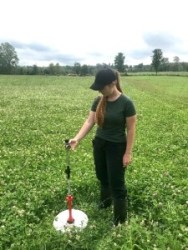
Using a Rising Plate Meter as a Tool to Improve Pasture Management: Summer Project 2021
The author of this article is Mary O’Connor, an OMAFRA summer student who, under the supervision of James Byrne (OMAFRA Beef Cattle Specialist), assisted with this project. The article was first published in the October 2021 edition of Virtual Beef. Introduction In Canada, grazing land, consisting of natural and planted pastures, accounts for approximately 50 million acres (Statistics Canada, 2011). Pastures provide numerous benefits to the producer, animals, and the surrounding environment. Grazing livestock on pasture provides economic benefits to the producer by supplying nutritious low-cost feed for livestock and utilizing marginal land not suitable for crop production (OMAFRA, 2015). Measuring and monitoring pasture growth on a regular basis can improve pasture performance, pasture productivity and livestock performance. A rising plate…

Pregnancy Scanning: Management Tips
This blog post was adapted from the OMAFRA Factsheet “Pregnancy Scanning: Management Tips” (AGDEX 433/22) by A. O’Brien. Introduction Pregnancy scanning, using real-time ultrasound equipment, is a useful management tool for Ontario sheep and goat producers. When scanning is performed within the recommended time frame by trained professionals, accuracy of identifying animals that are not pregnant and counting the number of fetuses is high. Pregnancy scanning can be used to assign open ewes to new breeding groups, make culling decisions, and optimize feeding management based on expected litter size. Benefits of Ultrasound Scanning Factors Affecting Ultrasound Scanning Accuracy For producers to get the maximum benefit from pregnancy scanning, factors affecting accuracy need to be well understood. Some of the factors…
Grazing Livestock and Forage Palatability: How They Go Hand in Hand
This article was written by Breann Saulnier, OMAFRA Grazing Livestock Assistant. You may look out into a pasture and see an abundance of tall, delicious-looking grass for livestock to graze but this is not necessarily what the livestock see. The amount of forage available for grazing is the portion of plant material that the animal chooses to eat, not the total amount of forage growing that is visible. So how do you know what the animal will choose to eat? Well, the palatability and the utilization of forage for animals is influenced by what stage of growth the grass is in. In the context of grazing, palatability refers to a measure of when animals are given free choice, choose to…
Make Better Use of Your Feed; Sampling is What You Need! Part 1: Taking a Proper Feed Sample
Learn about proper procedures for collecting feed samples.

Pest Alert: Alfalfa weevil and leafhopper numbers high
This article was written by Tracey Baute, OMAFRA Field Crops Entomologist and originally posted on FieldCropNews.com Alfalfa weevil and potato leafhopper (PLH) are being reported as extremely high in many fields. Hot dry conditions have made it more favourable for these pests than their natural enemies (especially entomopathogenic fungi). Scout fields to determine if cutting is possible or if an insecticide application is necessary if thresholds are reached. Consider fields at threshold if both pests are present but populations are slightly below threshold for either pest. Monitoring recently cut fields is extremely important as well, as infestations can overwhelm the young regrowth. Dry bean growers should also keep watch of their newly emerging dry bean plants for PLH as seed…
CAP Special Provisions and Farmer Mental Health Resources
Article: Owning a farm is much more than a business; it is a way of life. As with most businesses, there are some very stressful times that can weigh you down. During busy seasons or critical production periods, it is normal to be faced with time constraints and pressures and facing major financial issues can multiply these pressures many times. During these times, and with the added reality of COVID-19, these demands can put anyone involved in the business of agriculture under a great deal of stress, often impacting one’s mental health. The Ministry of Agriculture, Food and Rural Affairs (OMAFRA) cares about the well-being of farmers and farm families and recognizes the unique challenges that can lead to mental…