In July, OMAFRA hosted a series of webinars on topics related to goat genetic improvement. The webinars were held on July 20th, 22nd, 27th and 29th, with speakers presenting on aspects of genetics and genetic improvement programs for both meat and dairy goats. This post summarizes some of the key take-home messages from the presentations. If you’re interested in learning more, full video and podcast recordings of the presentations are available below. Click the links below to go directly to the presentation you’re interested in learning more about. Not sure where to start? Check out the Overview of Presentations to hear the key messages from all of our presenters. Overview of Presentations Keep or Cull: Strategies for Replacement and Culling…
All posts in 2021
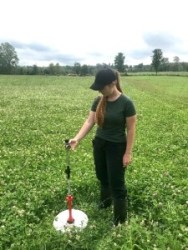
Using a Rising Plate Meter as a Tool to Improve Pasture Management: Summer Project 2021
The author of this article is Mary O’Connor, an OMAFRA summer student who, under the supervision of James Byrne (OMAFRA Beef Cattle Specialist), assisted with this project. The article was first published in the October 2021 edition of Virtual Beef. Introduction In Canada, grazing land, consisting of natural and planted pastures, accounts for approximately 50 million acres (Statistics Canada, 2011). Pastures provide numerous benefits to the producer, animals, and the surrounding environment. Grazing livestock on pasture provides economic benefits to the producer by supplying nutritious low-cost feed for livestock and utilizing marginal land not suitable for crop production (OMAFRA, 2015). Measuring and monitoring pasture growth on a regular basis can improve pasture performance, pasture productivity and livestock performance. A rising plate…

Pregnancy Scanning: Management Tips
This blog post was adapted from the OMAFRA Factsheet “Pregnancy Scanning: Management Tips” (AGDEX 433/22) by A. O’Brien. Introduction Pregnancy scanning, using real-time ultrasound equipment, is a useful management tool for Ontario sheep and goat producers. When scanning is performed within the recommended time frame by trained professionals, accuracy of identifying animals that are not pregnant and counting the number of fetuses is high. Pregnancy scanning can be used to assign open ewes to new breeding groups, make culling decisions, and optimize feeding management based on expected litter size. Benefits of Ultrasound Scanning Factors Affecting Ultrasound Scanning Accuracy For producers to get the maximum benefit from pregnancy scanning, factors affecting accuracy need to be well understood. Some of the factors…
Participants Needed Dairy Goat Cost of Production Project in Ontario
The goal of the Cost of Production project is to compile relevant data and analytics, from 2019-2021, for the dairy goat industry. The results can be used for producer self-assessment, industry benchmarking, maximizing efficiencies, evaluation of expansion and start-up opportunities, and developing industry strategies. Participating producers will be contacted by MNP to discuss the project and what is to be expected from them. In addition to data collection, participants in this project may be asked to test a benchmarking tool to help refine and improve a COP and Benchmarking tool. Participants will be asked to share: 2019, 2020, and 2021 financial statements 2019, 2020, and 2021 production information Management practices and data Participants in the project will: receive an individual…
Grazing Livestock and Forage Palatability: How They Go Hand in Hand
This article was written by Breann Saulnier, OMAFRA Grazing Livestock Assistant. You may look out into a pasture and see an abundance of tall, delicious-looking grass for livestock to graze but this is not necessarily what the livestock see. The amount of forage available for grazing is the portion of plant material that the animal chooses to eat, not the total amount of forage growing that is visible. So how do you know what the animal will choose to eat? Well, the palatability and the utilization of forage for animals is influenced by what stage of growth the grass is in. In the context of grazing, palatability refers to a measure of when animals are given free choice, choose to…

From the Backside to the Countryside – Manure Odours
This article was written by Christine Brown, OMAFRA Field Crops Sustainability Specialist. It was originally posted on FieldCropNews.com. There is no surer sign of spring in the countryside than the evidence from our noses of manure application in full swing. Odour complaints occur every year, especially where urban settlements border livestock farms. Although manure odour is inconvenient, most farms do consider wind direction and make an effort to apply and incorporate manure as quickly as possible to minimize odours. Some farms are also looking at manure additives to help control odours. The combination of livestock species, feed ration and manure storages result in hundreds of complex compounds that can produce odorous gases. Some of these gases are dangerous, while others…
Make Better Use of Your Feed; Sampling is What You Need! Part 1: Taking a Proper Feed Sample
Learn about proper procedures for collecting feed samples.

Moisture Content and the Hay Drying Curve
Many management decisions affect hay quality. After deciding when to cut, the next big decision is about the moisture content. Accurately timing how long to let the crop wilt when harvesting a forage crop will help ensure that it stores well. It either needs to have enough moisture to ferment correctly (silage/haylage or baleage systems), or low enough moisture content to preserve as dry hay. There are three types of moisture to consider when wilting a forage crop: stem moisture, dew moisture, and air humidity. Stem moisture is the amount of water within the plant. Dew moisture is water outside the plant, whether it is from rain or condensation (dew). Air humidity affects how quickly the crop can dry. If…

Pest Alert: Alfalfa weevil and leafhopper numbers high
This article was written by Tracey Baute, OMAFRA Field Crops Entomologist and originally posted on FieldCropNews.com Alfalfa weevil and potato leafhopper (PLH) are being reported as extremely high in many fields. Hot dry conditions have made it more favourable for these pests than their natural enemies (especially entomopathogenic fungi). Scout fields to determine if cutting is possible or if an insecticide application is necessary if thresholds are reached. Consider fields at threshold if both pests are present but populations are slightly below threshold for either pest. Monitoring recently cut fields is extremely important as well, as infestations can overwhelm the young regrowth. Dry bean growers should also keep watch of their newly emerging dry bean plants for PLH as seed…

Slowing down the rotation protects pasture yield
Co-written by James Byrne, OMAFRA Beef Cattle Specialist Maximizing pasture yield requires management. One of the most important decisions a manager can make is to give their grass enough time to fully recover after being grazed. Pastures have fully recovered from a grazing event when the grass plants have 3-4 new leaves. At this stage they are palatable, nutritious, and have had time to store energy in their roots and lower stems to fuel regrowth the next time they are grazed. However, sometimes pastures do not recover from grazing as quickly as producers would like. Often this happens when there is a lack of sunlight, cold conditions or not enough rainfall. In these situations, grazing managers should look for ways…