A total of 83 producers submitted data, with 38.6% (32 producers) representing operations with flock sizes greater than or equal to 100. Note that most analyses broken down by flock size are based on 82 responses due to missing data. The results presented throughout this report are based on information from the 2025 production year unless otherwise noted. Years Owning Sheep 1-99 flock size: Producers that have owned sheep for 15+ years represent the largest group (23 producers). This is followed by 10-14 years (12 producers), then less than 5 years (10 producers), and 5-9 years (5 producers). 100+ flock size: Similarly, producers that have owned sheep for 15+ years also make up the largest share (21 producers). The remaining…
All posts in Business

Sheep farming is a complex system – how are you making your decisions?
This article first appeared in Ontario Sheep News. How many decisions do you make each day? Hundreds? Thousands? Regardless of how large or small your sheep operation is, farming is a complex system requiring many decisions. Decision making is a skill you need to practice and improve. For long term success, it is necessary to understand how you make decisions and to actively choose how farm decisions will be made. Grain and Graze Australia has done research into farm decision making to help farmers make better decisions. They believe that the only real difference between the top twenty percent of farmers and the rest is their ability to make the right decision at the right time. (Nicholson et al., 2015)…
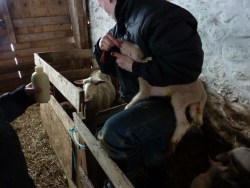
What is the workplace culture on your farm?
I recently read an article on farm labour shortage indicating that “the domestic labour pool is expected to drop largely due to an older-than-average workforce and few young entrants.” I have also heard conversations like, young people don’t want to work, or they don’t know how to work. Yet, I have also met some very motivated young people who are looking to start sheep farming and are finding the task of learning everything needed, financing an operation, etc. daunting. This is not a new issue and is governed by a complex matrix of factors. I would like to bring up one factor that I haven’t heard talked about often in the sheep industry and that is workplace culture. I know…
Do you have a water contingency plan?
In 2016, many areas of the province saw very warm and dry conditions, and many wells were still dry leading into the winter. In other years, like the start to the 2017 growing season, the province experienced periods of excessive rain, leading to saturated soils and flooding. Both situations create many challenges for livestock and poultry farmers. No one can control the weather, but we can plan for it. The Ministry of Agriculture, Food and Rural Affairs (OMAFRA) encourages you to plan for future weather – conserving water and using it efficiently can help during low water conditions, and having effective drainage systems in place can help with saturated soil and runoff. Things to consider for low water conditions: Things…
Use Sheep Behaviour to Your Advantage When Designing Handling Facilities
Sheep handling in “make-do” pens is not only hard, difficult work, it is outright unpleasant. As a result, important jobs like vaccinating and deworming are often delayed or not done at all. Well-designed sheep handling facilities are essential to a successful sheep production operation. Few other investments will create such labour efficiencies and savings. Most producers will only build, or purchase, one handling facility in their lifetime, so planning is essential. Incorporate existing paddocks, laneways and barnyards into the handling system to allow for ample space when the flock is held in the yards for long periods of time. Sheep need to move smoothly between these areas with a minimum of fuss. To achieve this, a producer needs to understand…
Ideas for Shearing Facility Design and Shearing in Ontario
Wool production is a year-long process. Yet it is during harvesting – a process that takes a matter of minutes – that quality is often adversely affected. Preparing your facilities and flock properly for shearing will make the job much easier and ensure quality does not suffer. Producers often assume that the shearer knows the best procedure for wool handling and preparation. However, it is the producer’s responsibility to make sure that animal handling is optimized and ensure buyers get the high-quality wool they desire. A number of factors go into designing and constructing a shearing facility that is effective for both workers and sheep. Read more in the OMAFRA factsheet Shearing Facility Design and Shearing in Ontario.
Farming and Agriculture Apps Directory
Farms.com has created an online directory of agriculture apps that will help farmers quickly find the apps that will help them get the most out of their smartphone accessing information they want. Find out more about the farming and agriculture apps directory.
OMAFRA’s Sheep Management Journal
The Ontario Ministry of Agriculture, Food and Rural Affairs (OMAFRA) has a new sheep management journal. Designed after the popular lambing diary, it is pocket sized and spiral bound. The book is designed to collect information generated on the farm throughout the sheep management cycle. Producers can collect information about things like: on sheep and feed inventories, ram in and out dates, total numbers of lambs weaned and marketed, numbers of animals and days on pasture and health treatments. The book is divided into four main sections: animal management, health management, stored feed management and pasture management. This book provides a low tech method of recording much of the basic information needed to do a basic evaluation of sheep farm…
Marketing Your Lambs
The Alberta Lamb Producers have added a new module to their management modules called Marketing your Lambs. Although the publication is focused on Alberta, there is good information on lamb quality and marketing options that can be applied in Ontario. Click on the cover photo below to access the manual.
Sheep Reproduction Basics and Conception Rates
To run a profitable sheep operation, producers must understand the details of many different disciplines and how they interrelate. One of the basic aspects of a sheep farming operation is to make sure that ewes become pregnant and have lambs. It is important to understand the basic physiology of the reproductive cycle to ensure that management decisions do not prevent ewes from becoming pregnant. Conception rate varies between season, age, breed and lambing system. Understanding the effect of these factors will enable you to determine what a good conception rate is for your farm. Read more in the OMAFRA factsheet Sheep Reproduction Basics and Conception Rates.