This article was written by Dr. Lisa Sharko. The California Mastitis Test (CMT) is a rapid, on-farm screening tool used to detect mastitis in lactating ruminants by estimating the number of somatic cells in the milk. It is a cost-effective test that can be performed quickly by producers, providing immediate results. The CMT can be used to evaluate individual animals or to screen larger production groups, such as fresh does. While the test is simple to perform, accurate interpretation requires training and experience. Producers are encouraged to work with their herd veterinarian to review testing techniques, develop a testing strategy, and establish response protocols based on test results. CMT kits are available through veterinary clinics and agricultural supply retailers that…
All posts in Sheep
Sheep Production Systems Questionnaire Results
A total of 83 producers submitted data, with 38.6% (32 producers) representing operations with flock sizes greater than or equal to 100. Note that most analyses broken down by flock size are based on 82 responses due to missing data. The results presented throughout this report are based on information from the 2025 production year unless otherwise noted. Years Owning Sheep 1-99 flock size: Producers that have owned sheep for 15+ years represent the largest group (23 producers). This is followed by 10-14 years (12 producers), then less than 5 years (10 producers), and 5-9 years (5 producers). 100+ flock size: Similarly, producers that have owned sheep for 15+ years also make up the largest share (21 producers). The remaining…
Looking for your Opinions and Basic Sheep Production System Information
I am interested in understanding more about the current production systems used by Ontario sheep farmers. This is a short, anonymous questionnaire. I am hoping to hear from as many producers as possible. Link to Questionnaire: https://forms.office.com/r/g6QMZRnZ0y The answers to the Sheep Production System Questionnaire will provide: If there are at least 30 participants, I will summarize the results and make them available on our blogsite https://sheepandgoatproduction.ca/ and publish them in an article in the OSF messenger. I appreciate your time and any information you can provide. Delma Kennedy, Sheep Specialist, Ontario Ministry of Agriculture, Food and Agribusiness
Frost Seeding FAQ
Frost seeding is a popular way to renovate an existing forage stand and is most effective in fields where patches of bare soil at least the size of a loonie are visible. With spring around the corner, many producers have questions about how to best use this technique to improve their hay fields and pastures. When can I frost seed forages? The optimum time to frost seed is when the snow has melted, but the ground is still frozen. Waiting until there is bare soil prevents the seed from being washed away with melt water. Frozen ground can support the weight of equipment and prevent ruts and compaction. Often the ideal window for frost seeding is very short, and sometimes…
Machine Options to Reduce Labour when Feeding Milk Replacer
Introduction Artificially rearing lambs and kids is costly and labour intensive. Investing in a machine to help reduce the labour costs associated with feeding is something to consider. There are various types of milk replacer machines on the market. Which type of machine is best suited for an operation depends on the size of operation, current infrastructure and budgets. This article aims to introduce three types of milk replacer machines. Automatic Milk Machine (e.g. Grober/Forester Technik) Automatic milk machines continuously mix small portions of milk replacer for ad libitum milk feeding. A common machine in Ontario is sold by Grober in partnership with Forester Technik. This machine allows for portions to be set and counted and has various features to…

State of the Ontario Sheep Industry Fall 2025
Original article written by Christopher Llewellyn and Delma Kennedy and updated by Kristy Blankers and Delma Kennedy. Highlights Market Demand Inventory Trends Market Prices Lamb Supply Slaughter and Trade Wool Market Demand Domestic Protein Demand In Canada, the average annual consumption of various animal proteins reveals distinct dietary preferences. Figure 1 shows that poultry leads with poultry at 40.79kg per person, followed by beef at 16.77 kg and pork at 15.63 kg. Eggs also contribute significantly to the diet, with an average consumption of 21.73 dozen. Lamb and mutton, however, account for a small share, averaging just 1.09 kg per person per year. Comparing this to the previous year, when lamb and mutton consumption was 0.94 kg, there has been an…

Frost Injury in Sorghum Species
Caution! Members of the sorghum family – sorghum, sudangrass, and hybrid sorghum-sudangrass – contain dhurrin, a glucoside that breaks down to release hydrocyanic acid, also known as prussic acid (hydrogen cyanide, HCN). A sudden disruption of growth such as frost, drought or cutting, causes prussic acid to be released inside the plant at a more rapid rate. High prussic acid levels may be lethal to ruminants; death often occurs within 20 minutes of ingesting sorghum forage with elevated prussic acid concentrations. Early fall, between the first frost and the first killing frost, is the riskiest time of year for prussic acid production in sorghum species. These warm-season grasses are very frost-sensitive. It is impossible to know by looking at them…

Influence of BCS and Weight on Sheep Performance
This article was written by Kristy Blankers and Delma Kennedy Introduction Animal efficiency is important to a livestock farm’s bottom line. Therefore, it is beneficial to select for animals that are able to wean more kilograms of lamb per kilogram of mature body weight. Animal performance is influenced by a ewe’s body condition score (BCS) and body weight. To effectively select animals that are more efficient, body weight and BCS must be taken into consideration. Over the past four years, BCS, body weight, and performance data has been collected on farm with the objective of being able to create a genetic evaluation model to select animals that can maximize production per kilogram of mature body weight. With three breeding seasons…

Scrapie Infosheet
This infosheet is by the Canadian Food Inspection Agency (CFIA) What is scrapie and why is surveillance important? Scrapie is a very rare, devastating disease that affects the central nervous system of goats and sheep. It is in the same class of diseases as bovine spongiform encephalopathy (BSE) in cattle and chronic wasting disease (CWD) in elk and deer. Like these diseases, once an animal is infected with scrapie, it is always fatal. Sheep and goats can get scrapie by either coming into direct contact with the saliva, urine, feces, blood or birthing fluids of an infected animal, or indirectly by ingesting anything from, living in or spending time in a contaminated environment like a barn or pasture. Males are…
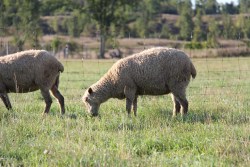
Managing Forage Crops and Pastures in Hot and Dry Conditions
This list details actions Ontario farmers could take to increase feed inventory before, during, and after prolonged hot and dry conditions.