This article was written by Tracey Baute, OMAFRA Field Crops Entomologist and originally posted on FieldCropNews.com
Alfalfa weevil and potato leafhopper (PLH) are being reported as extremely high in many fields. Hot dry conditions have made it more favourable for these pests than their natural enemies (especially entomopathogenic fungi). Scout fields to determine if cutting is possible or if an insecticide application is necessary if thresholds are reached. Consider fields at threshold if both pests are present but populations are slightly below threshold for either pest.
Monitoring recently cut fields is extremely important as well, as infestations can overwhelm the young regrowth. Dry bean growers should also keep watch of their newly emerging dry bean plants for PLH as seed treatments will only protect the plants for a few weeks after planting.
Alfalfa weevil
Alfalfa weevil larvae initially feed within the leaf buds and then move to the tips of the plant. Pinholes are the first signs of damage but can quickly progress to skeletonized leaves. Heavily damaged fields will look greyish white from a distance. Heavy feeding not only impacts yield but also reduces feed quality. Fields at greater risk of alfalfa weevil include those seeded last year, pure alfalfa stands, and areas of the field with south facing slopes.
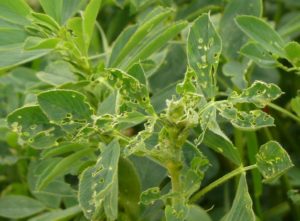
Alfalfa weevil scouting involves using a pail and tape measure. While walking an M shaped pattern across the field, collect 30 stems by cutting or breaking them off at ground level. Measure the height of the plants. Shake each plant against the side of the pail to knock off the larvae. Count only the 3rd and 4th instar larvae. Smaller 1st and 2nd instar larvae are pale yellow and lack the white stripe along their bodies. Don’t count larvae that are slow moving and are tan or yellow in colour, they are infected by a fungus or parasitoids and will die shortly.
| Plant Height | # of larvae per stem | Action Needed |
| Any height | less than 1 larva | no action required, but continue to monitor |
| Less than 30 cm (12″) | more than 1 larvae | Cut the crop. If cutting is not possible, spray. |
| Less than 40 cm (16″) | more than 2 larvae | Cut the crop. If cutting is not possible, spray. |
| Any height | more than 3 larvae | Cut the crop. If cutting is not possible, spray. |
Potato Leafhopper
Potato leafhopper arrived recently on storm fronts from the US in heavy numbers. Most vulnerable are new seedlings and young regrowth but all stands need to be monitored frequently (twice a week at least). PLH nymphs and adults suck out plant sap while injecting a toxin into the plant that interferes with transportation of nutrients in the leaves and stem. The result is the characteristic “hopperburn”, which starts as a wedge-shaped “V” yellowish pattern at the leaf tips. By the time hopperburn is noticed, yield and quality have been compromised. The taller the alfalfa, the more leafhoppers can be tolerated before control is necessary. Though PLH-resistant varieties of alfalfa are available, new seedings are still vulnerable, as the glandular hairs are not fully expressed the first year. Use the conventional thresholds below for first year seedings of these resistant varieties.
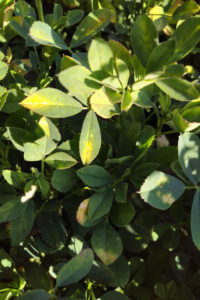
PLH scouting involves using a sweep net. Take 20 sweeps (180 degrees from side to side) across the crop canopy from five areas of the field. Determine the average number of PLHs per sweep. Next, take 20 alfalfa stems at random and record the average plant height.
| Plant Height | Number of PLH per Sweep (one sweep = one 180 degree arc) |
| 9 cm (3.5″) | 0.2 adults |
| 15 cm (6″) | 0.1 adults |
| 25 cm (10″) | 1 adult or nymph |
| 36 cm (14″) | 2 adults or nymphs |
Management: If the timing is right and the crop is ready, cutting the crop is the preferred and effective method of control, avoiding the costs of spraying and risk to pollinators and natural enemies. Cutting removes large numbers of alfalfa weevil larvae or potato leafhopper nymphs. In heavy infestations, these pests can stick around or in the case of PLH, adults re-infest fields and cause damage to the early growth of the second crop so scouting is recommended again after first cut.
Cutting before the bud stage an result in extensive damage to second cut regrowth and lower yield. If the crop is not ready to cut, insecticides are the recommended control option. Spray in the evenings to avoid harming foraging bees and contact local beekeepers prior to spraying so that they can move or protect the hives during the spray.
Registered products for alfalfa weevil and potato leafhoppers can be found in the Crop Protection Hub . If both pests are present and require control, only lambda-cyhalothrin products are registered for both pests.