From March to August 2022 an on-farm project on artificial rearing systems specifically focusing on milk machines and lamb performance was conducted at several Ontario farms. The project had three main objectives: lamb productivity, rearing cost, and producer labour. The results will be presented in a series of articles; this article will focus on-farm set-ups, machine cleaning and milk replacer cost.
Six farms participated in the project. Two farms had Lac-Tek milk machines and four farms had Eco Feeders also commonly known as Förster-Technik and / or Grober refer to Figure 1. The total number of ewes represented on the farms was 3395, with flock sizes of 400, 825, 120, 1000, 450 and 600 respectively. Two farms kept artificially reared lambs on slatted floors while the other four bedded using straw, shavings, or a combination.
Figure 1: Two types of milk machines in the on-farm project, a Lac-Tek and an Eco Feeder also commonly known as Förster-Technik and / or Grober


On-Farm Pen Set-Ups
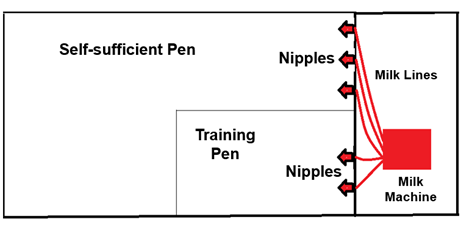
All farms had at least a two-pen artificial rearing system as seen in Figure 2. In this set-up the lambs are placed into the training pen, trained for at least a 24-hour period and then moved to the self-sufficient pen once they are drinking from the milk machine. The red box is the milk machine and the milk lines run from the machine to the pens with training pen milk lines being shorter so it is easier for lambs to draw from the machine. Nipples are placed at the milk line of the machine so the lamb is able to get milk easily. In the self-sufficient pen, the milk lines are longer and nipples are placed above the milk line to make the lambs work to get the milk, meaning the milk is less likely to spill on the floor if a nipple is chewed.
Figure 2: A schematic of a two-pen artificial rearing system, showing the ‘training pen’ lambs are started in, and the ‘self-sufficient pen’ they ‘graduate’ to
During the training phase, some producers used a ‘5-dot training system’ which worked well. The lambs would be placed on the machine and each time the producer worked with the lamb to get them sucking on the nipple, a dot was sprayed on the lamb. The fifth time the lamb was worked with, the producer would either spray a fifth dot or, in the one case, would put a line through the four dots to represent the fifth and final training session as in Figure 3. The lamb would then be put into the self-sufficient pen and monitored.
Figure 3: Lambs in the training pen managed using the ‘5-dot training system’

Most of the farms in the project had their milk machines in warm rooms to avoid freezing. In some cases, the machines were in existing offices or ‘mechanical’ rooms. In other cases, the room was built around the milk machine and heating installed.
Productivity Data
Lamb productivity data was collected with Table 1 showing the weaning weights that producers targeted, or the weaning goal. It also shows the actual average weaning weights. This varied on some farms; one farm had labour challenges and on two farms the group sizes were small. A critical mass of lambs is needed to keep the machine running, and for this reason, the lamb weights exceeded the target weight. The average number of days the lambs were on the milk machine as well as average daily gain were also calculated and can be seen in Table 1. On average, the number of days a lamb was drinking milk on the machine was 38 days.
Table 1: Summary of lamb weaning and performance data by farm and group
| Farm 1 | Farm 2: Group A | Farm 2: Group B | Farm 3 | Farm 4 | Farm 5 | Farm 6 | |
| Weaning Goal (lbs) | 20 | 20 | 20 | 30 (or 30 days) | 25 | 30 days | 20 |
| Actual Weaning Weight (lbs) | 22 | 21 | 23 | 22 | 34 | 35 | 26 |
| Average # days on milk machine (days) | 40 | * | 36 | 38 | 44 ** | 33 | 34 |
| Average daily gain (lbs) | 0.41 | * | 0.45 | 0.38 | 0.47 | 0.78 | 0.46 |
** Data from 15 out of 44 lambs – couldn’t correlate the other lambs due to lack of data
Milk Machine Cleaning
Four out of the six farms cleaned their milk machines either on a daily or every-other-day basis. Cleaning the machine regularly is critical in preventing death loss and reducing health challenges. Four farms had two sets of milk lines where the dirty set of milk lines were taken off and cleaned and the other clean lines were swapped onto the machine. In terms of cleaning, the cleaning protocols were all different. However, there were several farms using dish soap to clean the machines; dish soap is not recommended to clean a milk machine as it doesn’t kill bacteria in the lines and leaves a residue which can lead to more milk residue and therefore bacteria. Instead of dish soap, an alkaline milk pipeline cleaner should be used which are generally chlorine based and will efficiently remove milk residues in milk lines and in the mixer on the machine. All parts that come into contact with milk should be rinsed, scrubbed with a milk pipeline cleaner and then rinsed again. These products can be bought anywhere that sells dairy milking equipment or at some farm stores. If using a pipeline cleaner, it is important to wear gloves while cleaning to avoid burning your hands.
Rearing Cost – Milk Replacer
Spending per lamb on milk replacer powder was calculated on each farm. There was a range of $31 to $72 spent per live lamb weaned with an average of $52 spent per live lamb weaned. Individual farm values and variability can be seen in Figure 4.
Figure 4: Milk replacer cost per live lamb weaned by farm and group.

There were several factors which led to the variability in milk replacer spending including:
- Missing lambs
- Leaking or spilled milk
- Milk replacer price
- Death loss
- Weaning weights
Producers were often busy with lambing and other jobs on the farm and some lambs did not get weighed out of the system, either at weaning or in the case of death. For project purposes, these lambs were counted as ‘missing’. This would impact some farms’ dollars per live lamb spent on milk replacer as some of the live lambs not recorded have decreased the overall amount fed and spent per live lamb weaned.
Some farms also had leaking milk from nipples that had been chewed off by the lambs. One nipple that worked well on some farms and did not tend to be chewed, was the grey ‘caprine nipple’. See Figure 5 for an example.
Figure 5: Grey ‘caprine nipple’ which did not tend to get chewed off by the lambs

Two farms experienced human error, where the milk lines were not attached properly to either to the machine or the nipples. In this case, half or full bags of milk powder were mixed and spilled on the floor as liquid due to the machine running continuously until the producer came back and noticed the problem.
The purchase cost of milk replacer did affect the variability in cost per live lamb weaned on farms. The market price of milk replacer increased over the duration of the study. As an example, one farm was paying $85 per bag of milk replacer in February 2022 and by May 2022 the price had increased to $114 per bag. Individual farms were paying different average prices for milk replacer, which can be seen in Table 2 along with the amount of milk replacer consumed per live lamb. The average amount of milk replacer consumed per live lamb across the six farms was 10 kg or half a bag of milk replacer.
Table 2: Milk replacer cost and amount consumed per lamb
| Farm 1 | Farm 2: Group 1 | Farm 2: Group 2 | Farm 3 | Farm 4 | Farm 5 | Farm 6 | |
| Average Milk Replacer Cost/ Bag | $103 | $97 | $103 | $100 | $115 | $105 | $96 |
| Amount of milk replacer consumed per live lamb | 9.7 kg | 9.0 kg | 6.8 kg | 6.3 kg | 11.8 kg | 11.7 kg | 15.0 kg |
Observations / Key Findings
When considering the rearing cost of raising lambs on a milk machine, three main factors impact the cost per live lamb weaned including the milk replacer cost, death loss and actual weaning weights.
- While the cost of milk replacer is a variable, producers may want to look at buying in bulk or comparing prices from a few different stores. Buying in bulk does come with challenges in terms of trying to keep it fresh and rodent control.
- The average amount of milk replacer consumed per live lamb across the farms was 10 kg. Another way of looking at this is on a 20 kg bag of milk replacer, the average amount of milk replacer consumed per lamb was half a bag.
- Cleaning milk machines regularly is extremely important to reduce death loss and health challenges. A milk pipeline cleaner should be used to clean the machine and milk lines instead of dish soap.
Thank you to the six farms who participated in the on-farm study. Your participation is greatly appreciated and allowed us to collect some meaningful benchmarks for lambs raised on milk machines.