On August 17th and August 19th 2023, Ontario Goat hosted a hoof health clinic emphasizing the importance of hoof trimming and preventing hoof diseases in your goats. Featured speakers included Dr. Gosia Zoebel (New Zealand), Susan Schoenian (University of Maryland), Dr. Emily zur Linden (Metzger Veterinary), and Dr. Lauren Wilson (Cornwallis Veterinary Services). Inspired by the event, this blog post discusses the importance of hoof trimming and outlines hoof ailments that you may be concerned about in your sheep and goats. Hoof Trimming In intensive systems, like those in Ontario, animals are typically housed on soft surfaces that don’t allow for natural wearing of the hooves. Allowing hooves to overgrow and become deformed can cause permanent damage and increase susceptibility…
All posts in Goats
Transporting Livestock: Understanding a Transfer of Care Form vs. an Animal Transport Record
Whether you’re a commercial transporter or a producer transporting your own animals, it is important to keep records on the movement of animals to ensure that animals are being responsibly taken care of and humanely transported. You can do this by filling out a Transfer of Care form and an Animal Transport Record. But what’s the difference? Transfer of Care Form What is its purpose? The purpose of a Transfer of Care Form is to ensure that animals are not left at slaughter facilities, assembly centres, or auctions without evidence that the care has been transferred from the transporter to the receiver. This form only applies for animals that are delivered to slaughter, assembly, and auction facilities. After the recipient…
Short Video Tutorials for the Dairy Goat Cost of Production Benchmarking Tool
This series of short videos have been created to help guide producers through the process of using the Dairy Goat Cost of Production Benchmarking Tool in Excel. Each video covers an individual producer tab. Providing step-by-step instructions on how to enter the data correctly into the cells. Along with highlighting some of the information calculated and provided by each tab. To get the most out of the tool producers should try to fill out the information as completely and accurately as possible. Access all the videos here. Learn more about and access the Dairy Goat Cost of Benchmarking Tool here. Introduction Video This video provides a general overview of the tool. Covering some benefits of using the tool, the information…
Dairy Goat Cost of Production Calculation and Benchmarking Tool
The purpose of this tool is to help dairy goat producers calculate their cost of production per litre and per doe, and to compare individual results to an industry benchmark; the aggregated performance results of other producers within the Ontario dairy goat industry. The industry benchmark is based on an average of production information from the 2019 to 2021 calendar years. The benchmarks represent production information from a sample of participating farms in the province and may not necessarily be statistically significant as representing the dairy goat industry as a whole. Excel is required to run this tool. Download a copy of the Excel spreadsheet tool below (Updated: March 27, 2023) Need help navigating the tool? View the Goat COP…
New! Publication 30: Guide to Forage Production
Publication 30: Guide to Forage Production is a comprehensive guide to forage agronomy. It has information on establishment, fertility, weed management and weather stress for many species grown as forage in Ontario. It also covers harvest and storage of forage crops and understanding a laboratory forage analysis. To download a free PDF version or order a paper copy, click here. ~~~~~~ La Publication 30F, Guide de production fourragère, constitue une source de renseignements détaillés sur les pratiques agronomiques en production fourragère. On y trouve de l’information sur l’établissement, la fertilité, la lutte contre les mauvaises herbes et le stress thermique, applicables à de nombreuses espèces végétales cultivées comme plantes fourragères en Ontario. Ce Guide traite aussi de questions concernant la récolte et l’entreposage des fourrages et…
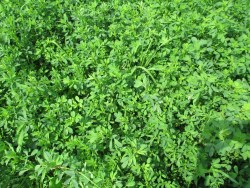
Is the yield potential of alfalfa increasing?
The relationship between alfalfa breeding efforts and yield potential is complicated. While most literature on annual grain crops shows yield improvements with the release of new varieties over time, a literature search on alfalfa yield will show improvement, stagnation, and declines, depending on the paper. One of the latest attempts to discern what is really going on comes from Lei Ren and colleagues out of the University of Saskatchewan. Ren and colleagues summarized data from the Western Forage Variety Testing System from 1997 to 2011 to see how breeding has changed the yield potential of alfalfa varieties over time. They recognized that environmental conditions and harvest management are factors that can affect alfalfa yield that are not always included in…

Blister Beetles
Description Blister beetles are very rare in Ontario but have been occasionally found in alfalfa fields north of Lake Erie. They are more common in arid climates, such as the U.S. Midwest, and are often associated with grasshopper infestations. The three most common species are the black blister beetle (Epicauta pensylvanica), the ash grey blister beetle (Epicauta fabricii) and the striped blister beetle (Epicauta vittata). Blister beetles have soft bodies 1–2.5 cm (3/8 –1 in.) long. The thorax between their head and abdomen is long and narrow, making it look like a neck. Their wings tend to be shorter than their abdomen. The black and ash-grey blister beetles are solidly coloured as their names describe (Figures 1 and 2). The…
Goat Genetic Improvement Webinar Series – Key Messages
In July, OMAFRA hosted a series of webinars on topics related to goat genetic improvement. The webinars were held on July 20th, 22nd, 27th and 29th, with speakers presenting on aspects of genetics and genetic improvement programs for both meat and dairy goats. This post summarizes some of the key take-home messages from the presentations. If you’re interested in learning more, full video and podcast recordings of the presentations are available below. Click the links below to go directly to the presentation you’re interested in learning more about. Not sure where to start? Check out the Overview of Presentations to hear the key messages from all of our presenters. Overview of Presentations Keep or Cull: Strategies for Replacement and Culling…

Pregnancy Scanning: Management Tips
This blog post was adapted from the OMAFRA Factsheet “Pregnancy Scanning: Management Tips” (AGDEX 433/22) by A. O’Brien. Introduction Pregnancy scanning, using real-time ultrasound equipment, is a useful management tool for Ontario sheep and goat producers. When scanning is performed within the recommended time frame by trained professionals, accuracy of identifying animals that are not pregnant and counting the number of fetuses is high. Pregnancy scanning can be used to assign open ewes to new breeding groups, make culling decisions, and optimize feeding management based on expected litter size. Benefits of Ultrasound Scanning Factors Affecting Ultrasound Scanning Accuracy For producers to get the maximum benefit from pregnancy scanning, factors affecting accuracy need to be well understood. Some of the factors…
Participants Needed Dairy Goat Cost of Production Project in Ontario
The goal of the Cost of Production project is to compile relevant data and analytics, from 2019-2021, for the dairy goat industry. The results can be used for producer self-assessment, industry benchmarking, maximizing efficiencies, evaluation of expansion and start-up opportunities, and developing industry strategies. Participating producers will be contacted by MNP to discuss the project and what is to be expected from them. In addition to data collection, participants in this project may be asked to test a benchmarking tool to help refine and improve a COP and Benchmarking tool. Participants will be asked to share: 2019, 2020, and 2021 financial statements 2019, 2020, and 2021 production information Management practices and data Participants in the project will: receive an individual…