This list details actions Ontario farmers could take to minimize the impacts of hail damage after a storm.
This list details actions Ontario farmers could take to minimize the impacts of hail damage after a storm.
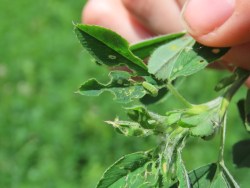
Alfalfa weevil is a major alfalfa pest in Ontario. Larvae feeding on alfalfa leaves can reduce both yield and forage quality. The simple answer As alfalfa gets taller it can tolerate more weevils before action is necessary to protect forage yield and quality. Action thresholds for managing alfalfa weevil are as follows: Stem Height Number of larvae per stem Up to 30 cm (12 in.) More than 1 Up to 40 cm (16 in.) 2 or more Any height More than 3 A little more information Alfalfa weevil larvae begin feeding in mid- to late-May, beginning with the leaf buds. The larvae then move to leaves near the stem tips, where damage starts off as pinholes (Figure 1) and progresses…
Frost seeding is a popular way to renovate an existing forage stand and is most effective in fields where patches of bare soil at least the size of a loonie are visible. With spring around the corner, many producers have questions about how to best use this technique to improve their hay fields and pastures. When can I frost seed forages? The optimum time to frost seed is when the snow has melted, but the ground is still frozen. Waiting until there is bare soil prevents the seed from being washed away with melt water. Frozen ground can support the weight of equipment and prevent ruts and compaction. Often the ideal window for frost seeding is very short, and sometimes…
This article was written by Kristy Blankers and Delma Kennedy. Introduction After a normal lactation (NL), extended lactation (EL) goats start a second lactation curve during the production period at about 330 days when milk yield begins to increase again. Figure 1 compares the lactation curves of goats in normal and extended lactations over a two-year period. Figure 1; Lactation curves in goats in extended lactation compared to the lactation curves of goats in two subsequent normal lactations (Douhard et al., 2013). Differences between the normal and extended lactation curves include: Weight Change Goats maintain their weight when they aren’t bred and start to gain weight after 330 days when milk yield begins to rise as shown in figure 2.…
This article was written by Kristy Blankers and Delma Kennedy. Introduction This summer, a benchmarking project was undertaken to determine how goats can be efficiently body condition scored and to collect industry information on typical body condition scores in different stages of lactation. In December 2023, a questionnaire was sent out through the Dairy Goat Digest to collect information on how body condition scoring is used in the industry and the need for additional resources on body condition scoring goats. The results of the survey and summer project are outlined below. Survey Results Thank you to those who took the time to complete the survey! There were 33 producers who responded to the survey. Of the respondents 51.5% were milking less…