This article was written by Kristy Blankers and Delma Kennedy.
Introduction
After a normal lactation (NL), extended lactation (EL) goats start a second lactation curve during the production period at about 330 days when milk yield begins to increase again. Figure 1 compares the lactation curves of goats in normal and extended lactations over a two-year period.

Figure 1; Lactation curves in goats in extended lactation compared to the lactation curves of goats in two subsequent normal lactations (Douhard et al., 2013).
Differences between the normal and extended lactation curves include:
- More milk in 1st period of production when goats don’t have to become pregnant.
- No dry period in extended lactation goats.
- Later, lower peak in lactation for extended lactation goats.
- Overall, no significant difference to total milk produced over the 2 years but extended goats were bred and dried off slightly later.
Weight Change
Goats maintain their weight when they aren’t bred and start to gain weight after 330 days when milk yield begins to rise as shown in figure 2. Douhard et al, 2013 determined this was due to increased feed intake. The goats in this study were fed a total mixed ration at a rate resulting in 10% refusal.
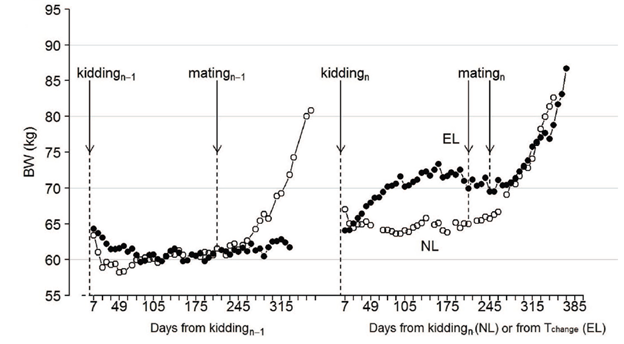
Figure 2; shows the body weight changes of a goat in an extended lactation (EL) compared to the body weight changes of a goat in two subsequent normal lactations (NL) (Douhard et al., 2013).
Interestingly the author noted variability among individual goats with some goats putting more energy into milk yield than body weight gain. After their second peak in lactation EL goats had similar patterns of body weight change to NL goats.
Using Extended Lactations as a Management Strategy
Potential Benefits
- Milking longer could improve out of season milk supply
- Fewer lifetime pregnancies reduce the number of times a goat will enter the peak period of risk for metabolic stressors (early lactation after kidding).
- Fewer pregnancies could reduce overall mortality and morbidity associated with pregnancy and kidding.
- Fewer pregnancies could result in goats staying in the herd longer reducing the number of replacement goats needed per year and fewer replacements would be a reduced cost.
- Open does can continue to contribute milk and have more opportunities for rebreeding.
- Extend lactation in first lactation goats reduces metabolic stress as the goat continues to grow as well as lactate.
- Cull goats who are still producing may add to the milk supply increasing the average lifetime production per goat.
Potential Disadvantages
- Goats in extended lactation have been shown to have higher somatic cell counts.
- Higher somatic cell counts could be a risk to other goats.
- Extended lactation may produce fatter goats who could be harder to breed back later.
- Fewer pregnancies reduces number of kids for genetic selection of next generation and number of kids for market.
Considerations when choosing goats for extended lactation
- The most productive goats generally perform the best in extended lactation.
- Goats with low somatic cell counts will have better somatic cell counts in extended lactation than goats with higher somatic cell counts in normal lactation.
- Cremoux, 2024 studied use of EL in 2,103 goat herds in France – EL was most commonly used in first lactation (60%), when goats are still growing and milking or as the last lactation (23%), when goats would be culled anyway.
- Figure 3 shows the difference in 2 year performance of first and second lactation goats in extended lactation compared to contemporaries in normal lactation.

Figure 3: Lactation curves of goats placed in an extended lactation in their first or second parity compared two subsequent lactations (Boshoff et al., 2023).
In the study illustrated in figure 3:
- Goats in first lactation who were extended produced an average of 90kg less milk than those with two normal lactations.
- Goats in second lactation who were extended produced an average of 43kg more milk than those with two normal lactations.
- Total fat, protein and lactose yields were similar between single and extended lactations.
Extended lactations have the potential to improve health, out of season milk supply and cost of production. Research determining how to identify goats on farm who will perform best in extended lactation and partition more energy to milk production than to body weight is needed.
References:
Boshoff et al., Modeling daily yields of milk, fat, protein, and lactose of New Zealand dairy goats undergoing standard and extended lactations. Journal of Dairy Science (2023), *Modeling daily yields of milk, fat, protein, and lactose of New Zealand dairy goats undergoing standard and extended lactations (sciencedirectassets.com)
de Cremoux et al., Evaluation of careers and performances of goats with extended lactations. Small Ruminant Research (2024), https://doi.org/10.1016/j.smallrumres.2024.107198
Douhard et al., Characterization of a changing relationship between milk production and liveweight for dairy goats undergoing extended lactation. Journal of Dairy Science (2013), *Characterization of a changing relationship between milk production and liveweight for dairy goats undergoing extended lactation (sciencedirectassets.com)
Goetsch et al., Factors affecting goat milk production and quality, Small Ruminant Research (2011), *Factors affecting goat milk production and quality (sciencedirectassets.com)
Mezzetti et al., Effects of dry-off or continuous lactation in Alpine and Saanen dairy goats carrying single or double kids on peripartum metabolic profile, \ performances, and milk composition. Italian Journal of Animal Science (2024), Effects of dry-off or continuous lactation in Alpine and Saanen dairy goats carrying single or double kids on peripartum metabolic profile, performances, and milk composition