This article was written by Marlene Paibomesai and originally published in the August 2018 issue of the Dairy Goat Digest.
What is colostrum?
Colostrum is the first secretion from an udder after birth. Colostrum is rich in nutrients and immune factors, such as immunoglobulins and immune cells that are important for immune and digestive system development (Sanchez-Macias et al., 2014). Colostrum is higher in protein, fat, growth hormones and immune factors than milk.
Why do newborns need colostrum?
Unlike other mammals, ruminants transfer limited amounts of immunoglobulins and other immune factors from the dam to the fetus during pregnancy. Instead, the majority of immune factors are transferred through colostrum to the goat kid after birth. This is called passive immunity. Passive immunity protects a goat kid from developing disease while their immune response develops during their first few weeks of life. At birth, a goat kid has a limited ability to mount a strong immune response, which makes it susceptible to infections and potentially death.
What is failure of passive transfer?
Successful passive transfer of immunity through colostrum is when there is more than twelve milligrams per millilitre (mg/mL) of immunoglobulin G (IgG) concentration in the blood serum of the goat kids after feeding colostrum (O’Brien and Sherman, 1993). Arguello et al. (2004) showed that goat kids with less than five mg of IgG/mL of blood serum two days after birth had higher mortality rates within the first month of life compared to goat kids that had 15 mg of IgG/mL in blood serum. Therefore, it is important to ensure that a goat kid has received enough high quality colostrum at birth to see them through early life while their own immune response develops.
How do I measure colostrum quality?
Colostrum quality is related to the concentration of immunoglobulins in colostrum. High quality colostrum has 50 mg of IgG/mL of colostrum. Immunoglobulins make up one-third of the protein in colostrum (Rudovsky et al., 2008). Immunoglobulin G (IgG) makes up approximately 90 per cent of the immunoglobulins found in colostrum, and therefore makes IgG a good measure of colostrum quality (Sanchez-Macias et al., 2014).
Refractometers can be used to determine colostrum quality. Refractometers measure the Brix scale, which measures the amount of sucrose in a given liquid and is related to the specific gravity of that liquid. Refractometers are available in both optical and digital forms (Figure 1).
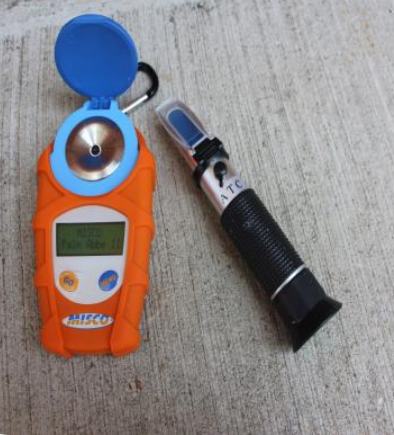
Figure 1. An example of a digital refractometer (left), and a temperature corrected optical refractometer (right).
Refractometer Research Project
In 2017, the Ontario Ministry of Agriculture, Food and Agribusiness conducted a research project to validate the use of refractometers to determine colostrum quality in dairy goats. From February to April 2017, researchers collected 10 milliliter (mL) samples of the first milking from 79 dairy does at three Ontario dairy goat farms. A digital and optical refractometer (Figure 1) were used to determine Brix value of the colostrum samples at 25°C, and an enzyme-linked immunosorbent assay (ELISA) was used to determine IgG concentration of the colostrum after sample preparation.
In this project, IgG concentration was determined by ELISA and Brix value using a digital refractometer. Brix value is moderately (R2=0.3312) related to IgG concentration of doe colostrum. In doe colostrum, 22 per cent Brix equals to 50 mg/mL of IgG in the colostrum, which is the minimum amount of IgG needed to provide goat kids with passive immunity. These results are similar to dairy cattle studies that have shown the 21 per cent Brix relates to 50 mg/mL of IgG in colostrum (Quigley et al., 2013). Further analysis is needed to confirm the results, and to determine the specificity and sensitivity of this method of colostrum testing.
In conclusion, refractometers are a method to test colostrum quality at goat side. Feeding colostrum to goat kids that contains at least 50mg of IgG/mL that equals 22 per cent Brix or higher will ensure that your goat kids are receiving enough IgG within the first 24 hours after birth.
References:
Arguello, A. et al. (2004) Effect of Colostrum administration practices on serum IgG in goat kids. Livestock Prod Sci. 90:235-239.
O’Brien, J. P. and D.M., Sherman. (1993) Serum immunoglobulin concentrations of newborn goat kids and subsequent kid survival through weaning. Sm. Ruminant. Res. 11(1):71-77.
Quigley et al. (2012) “Evaluation of the Brix refractometer to estimate immunoglobulin G concentration in bovine colostrum.” J Dairy Sci. 96:1148-1155.
Sanchez-Macias, et al. (2014) From goat colostrum to milk: Physical, chemical and immune evolution from partum to 90 days postpartum. J. Dairy Sci. 97(1):10 16.