This article was written by Mike Foran and originally published in the August 2018 issue of the Dairy Goat Digest.
Troubleshooting a high Bactoscan result can be one of the most frustrating issues a dairy goat producer encounters. A complete evaluation of milking equipment and bulk tank, and a review of the sanitation program is recommended. Often producers and equipment dealers will make minor or even significant upgrades to the milking system, yet high bulk tank Bactoscan results persist. In these cases, producers should consider that one or more goats are shedding high numbers of bacteria and may be the root cause of the high Bactoscan results.
Can one goat with high bacteria milk in a large herd spike the bulk tank Bactoscan result? The answer is yes. In fact when bulk tank Bactoscan results are in the millions it often comes from a single goat that is shedding high numbers of bacteria. It can be difficult to identify the goat that is producing the high bacterial count, because many times the milk from a problem goat will not show any clinical mastitis signs – no clots, flakes or off-coloured milk – and milk filters can appear normal. Group sampling can be used to help narrow the search for the goat causing the high Bactoscan results. There are various ways to collect group samples; here are some examples.
Large Group Sampling
A starting point might be to collect large group samples, beginning with an empty bulk tank. For example, a producer with four pens (100 goats per pen) may collect a sample from the bulk tank after each group has been milked, starting with Pen 1. Some interpretation of the results is required since the milk from Pen 2, 3, and 4 will be mixed.
| Bulk tank sampled after milking: | Bactoscan result (idc) | Somatic Cell Count (cells/ml) |
| Pen 1 | 20,000 | 700,000 |
| Pen 2 (mix of Pen 1 & 2) | 35,000 | 900,000 |
| Pen 3 (mix of Pen 1, 2, & 3) | 2,200,000 | 1,800,000 |
| Pen 4 (mix of Pen 1, 2, 3, & 4) | 1,600,000 | 1,400,000 |
In this example the problem goat(s) is most likely in Pen 3. Pen 4 also has a high Bactoscan result and goats in this pen cannot be totally ruled out. However, the Bactoscan result of Pen 4 – which is a homogenous mixture of all four pens – is likely to be somewhat lower than Pen 3 due to the fact that the Bactoscan result is lower after Pen 4 milk is added to the bulk tank and therefore diluted the high bacterial count of Pen 3.
Sample collection in this scenario will require a clean sanitized long handle sampling dipper (see Figure 1). Note: if milk from the first group is not hitting the agitator paddle, producers should try their best to mix the milk with a clean dipper in order to get a representative homogenous sample. Bulk tank sample collection is likely the easiest method; however, there are many techniques to obtain samples of milk in order to determine which goat(s) is producing the high Bactoscan results.
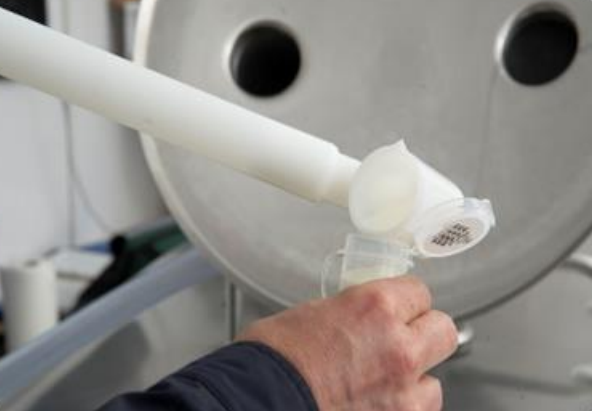
Figure 1. A clean, sanitized long handle sampling dipper is used for sample collection.
Group sampling via Quality Management, Inc. QMI Sample elbow
Producers may contact OMAFA dairy program to borrow this elbow. The elbow allows for the collection of representative sanitary samples from parlour groups. The elbow fits into 1.5 inch milk transfer lines between the milk pump and the tank. Every time the milk pumps from the receiver jar, a stream of milk can be collected (see Figure 2). If producers have an air blow system they can use this between groups to help remove residual milk in the transfer line. There will always be some residual milk in the system between parlour groups; however, high Bactoscan groups can usually be isolated. Goats from each group need to be identified and tag numbers need to be recorded. If goats are not tagged a system using coloured livestock markers can be used. The benefit of QMI sampling is that the samples are truly representative of the group of goats being sampled versus the bulk tank sampling method.
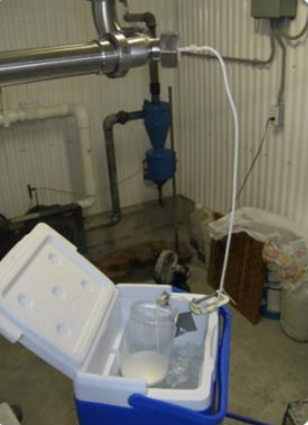
Figure 2. Group sampling using a QMI sampling elbow. Every time the milk pumps from the receiver jar, a stream of milk can be collected into a sample container.
Pipeline Systems
Producers with pipeline systems could simply hand milk a
few streams of milk from a group into a clean container and sub sample into the small sample bottle. Hand milking sample collection can work but the representativeness of the sample is not as good as with the sampling elbow and the risk of contamination is greater.
Bucket and Hand Milking Farms
Group sample collection is fairly straight forward on these farms. Milk from the bucket or pail should be mixed with a ladle or dipper prior to transferring the required amount to the small sample bottles.
Sample supplies, labelling, handling, and transport: Producers can contact their milk broker or OMAFA to obtain sample bottles. The bar coded producer label should be put on each group sample bottle. Use a permanent marker to indicate the group number on the sample bottle (see Figure 3).
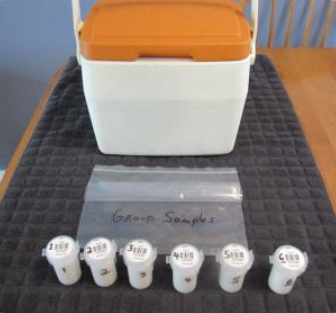
Figure 3. Properly labelled group sample bottles.
The sample bottles should be put in a zip lock bag to keep them dry and put in an insulated cooler or box. Ensure bags of milk samples are amply surrounded with ice in order to cool the milk as quickly as possible (see Figure 4).

Figure 4. Ensure sample bottles are cooled quickly before transportation to the lab.
Producers can work with their milk broker / transporter and OMAFA to arrange sample delivery to the University of Guelph lab. Contact OMAFA regarding sample submission procedures and forms.
A high Bactoscan group has been identified – what now? The California Mastitis Test (CMT) is one of the most effective tools a producer can use to identify a problem goat. Milk brokers have the Draminski conductivity meter which can also be useful; however, reviews are mixed. Using a strip cup with close and critical examination can also help. Cull or remove suspect goat(s) from the milking lineup going into the bulk tank until you receive acceptable bulk tank Bactoscan results. Individual goat milk samples could be submitted for Bactoscan and SCC testing. However, testing costs are significant, so testing samples from a small number of suspect goats is the best option to minimize costs.
Final Comments
Even the very best dairy goat managers can encounter goat related Bactoscan issues. However, if your farm has consecutive Bactoscan spikes multiple times per year and every year, take a step back and consider a team approach to improve milk quality. Your dairy equipment dealer, veterinarian, nutritionist, milk inspector and fellow producers can provide useful advice. As Henry Ford once said “If you always do what you’ve always done, you’ll always get what you’ve always got.”