Improving lamb survival is an ongoing discussion. At the June 2019 small ruminant veterinary conference in Guelph, a predominant theme was “Improving Lamb and Kid Survival”. Lamb survival is often complex and farm specific but researchers from different parts of the world are working on issues and details that affect the survival of small ruminants that may provide ideas to improve lamb survival on your farm.
Dr. Cathy Bauman, University of Guelph, talked about neonatal dairy small ruminant survival in intensive rearing conditions. Two important areas she discussed were record keeping and early life infections.
Record Keeping
To solve a complex problem, it is critical to keep ongoing records. Although it is difficult when many animals are being born at the same time, it is essential to determine when animals are dying and in what percentages. Post mortems also need to be done to narrow down the search for causes of death. At a young age, the cause of death might not be the illness that needs to be targeted. For example, a young animal with pneumonia could die of starvation because it doesn’t have enough oxygen to drink adequate milk through milk feeder nipples. As a result, Dr. Bauman recommends that mortality submissions be batched in groups of three or more. A complex problem like lamb survival is often multi layered so that as one issue is addressed, another is uncovered. This makes record keeping essential to make progress in this area.
Early life Infections
Good nutrition and maintenance of an optimum ewe body condition score throughout pregnancy is important for high quality colostrum production and good birth weights. Proper ewe vaccination and lamb naval dipping reduce infection. Hygiene is critical for young lambs on milk. Equipment used to feed milk must be kept very clean. Pathogens causing septicemia, joint infection and meningitis will grow in tubing and nipples can pass pneumonia from one lamb to another. Pen walls and bedding also need to be kept clean to reduce infection in these young animals.
Dr. Robert Suter, Agriculture Victoria Australia, talked about lamb survival in extensive operations. He stated that “Perinatal lamb survival is now recognized in Australia as the major production limiting disease in the sheep industry.” Research has been ongoing in the key areas of: ewe nutrition, causes of perinatal lamb mortality and genetics.
Ewe Nutrition
Optimal ewe nutrition throughout the management cycle has been shown to increase birth weight as shown in Figure 1. Birth weight increases significantly in both single and twin lambs as the ewe body condition score increases.
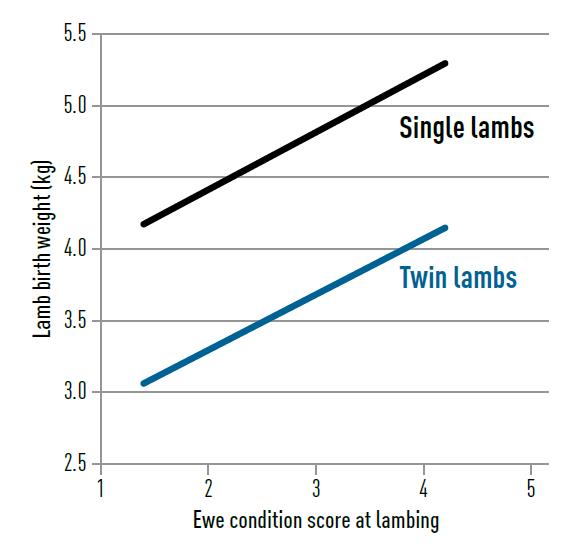
Figure 1 Ewes in better condition at lambing have heavier lambs. Source: Beyond the bale. Issue: 70 March 2017 pg 45 Lifetime Wool Australia.
The optimal birth weight for merino lambs has been determined to be 4.5-5.5 kg with decreased survival below 4.0kg. Improvements in birth weights lead to improvement in lamb survival. As shown in figure 2, although lamb survival improves with better body condition score in singles and twins, the increase in survival is much larger in the twin lambs.

Figure 2 Ewe condition score at lambing and lamb survival. Source: Beyond the bale. Issue: 70 March 2017 pg 45 Lifetime Wool Australia.
Research in Australia has also shown that better nutrition and ewe body condition score improve ewe lamb bonds and decrease mis-mothering all leading to better lamb survival rates.
Causes of Perinatal Lamb Mortality
A study of 18 farms and 2262 lamb post mortems in Victoria Australia identified key causes of lamb mortality. 48% of deaths were a result of the starvation-mismothering-exposure complex, 20% premature births and 14% due to dystocia. Most studies find that the most common cause of mortality in the first few days of life is caused by starvation-mismothering-exposure.
Australian research has fueled the development of the ASKBILL web-based software that predicts sheep well being and productivity by integrating weather, stock and pasture information for Australian producers. To provide tools to improve lamb survival, a wind chill index has been developed to predict weather events causing a high loss of young lambs on pasture. The index uses wind speed at lamb height, temperature and rainfall in the last 24 hours with an index of over 1000 kJ/M2.hour indicating a problem. ASKBILL now predicts the likelihood of a high chill day. Some producers are using shelter for lambing during high chill days to improve lamb survival.
Basic recommendations to reduce starvation and mismothering are to keep ewes and lambs on the birth site for a minimum of six hours, meet target body condition scores and feed on offer targets and lamb ewes scanned with multiples separate from those with singles. Recent research also recommends reduced mob sizes at lambing.
Mob Size
Research was done on 70 farms over two years looking at 2174 mobs of sheep. Sheep were separated into high and low mob size and high and low densities at day 140 after ram in date. The mob sizes and stocking rates were maintained until lamb marking or 160 +/- 10 days after the rams were removed at breeding. After accounting for ewe condition score, breed, feed on offer, topography, shelter, watering points, supplementary feeding and weather conditions, survival of twin lambs was better at low mob sizes compared to high mob sizes. Reducing the mob size by 100 ewes resulted in increased survival of twin lambs of 1.1% – 3.5%. Stocking rate did not impact survival. Typical on farm mob sizes ranged from 100 – 300 for ewes with singles and 60-200 for ewes scanned with twins. A general rule of thumb is that an optimum mob size for twins would be half the size of singles. Only a small amount of triplet data was included but suggested that reducing mob size for triplets would have an even greater effect on lamb survival than for twins.
Genetics
Australia has been exploring genomics to improve lamb survival. They have a Genetic Resource Flock that is funded by Meat and Livestock Australia. The flock started in 2007 with 5000 ewes on eight research stations. It is currently 2 flocks of 1,000 ewes that are bred to industry sires. Extensive data is collected on the ewes and progeny that is used to develop genomic breeding values on many traits that are not easily measured on farm. Related traits are also being explored to improve survival, like cold tolerance, repeatability of raising twins and lamb rectal temperature at birth.
Dr. Suter also discussed innovators in the Australian sheep industry. One of those innovators is Paradoo Prime. Paradoo Prime breed about 7000 Coopworth cross ewes per year and focus on a minimum threshold of 90% survival. This has been achieved by attention to detail. Breeding is done in three groups with shorter exposures to utilize feed resources and lambing paddocks more effectively. Ewes are pregnancy scanned and divided into separate mobs for singles, twins and triplets. They are body condition scored and fed to maintain condition throughout pregnancy and lactation with attention to feed budgeting and pasture conservation. Ewes are divided into smaller mobs when they are put into lambing paddocks. The target mob size for twin bearing ewes is 50 and for triplet bearing ewes no greater than 12 ewes in a group. Lamb survival by paddock is monitored and paddocks with the best results and the most shelter are allocated to twin and triplet mobs. Lambs are weaned between 8 and 9 weeks of age so that ewe mobs can be consolidated back into larger groups. Last year the flock had 180% conception and an 8% lamb loss between pregnancy scanning and weaning. That is 172% lambs weaned calculated from pregnancy scanning numbers.
Lamb survival is vitally important to sheep farm success. It is governed by many factors that all need attention when shepherds are the busiest. Attention to detail has allowed some Australian farms to increase the number of lambs weaned from .9 lambs to 1.7 lambs per ewe with a death loss from scanning to weaning of less than 10 percent. To improve lamb survival on your farm, evaluate hygiene, vaccination schedules, ewe body condition score, and consider smaller mob sizes for ewes with twins and triplets that are maintained until weaning. Work with your veterinarian to do post-mortems, ensure excellent hygiene and finally keep detailed lambing records to monitor progress.
Sources:
Ontario Small Ruminant Veterinary Conference Proceedings. June 2019.
Lifetime Wool Australia. Lamb survival increases with improved ewe nutrition. Beyond the bale. Issue: 70 March 2017 pg 45
Ask Bill, Sheep CRC Ltd. 2019. https://www.askbill.com.au/#/home accessed August 2, 2019
Australian Wool Innovation Ltd. 2019. Lowering mob size increases lamb survival. https://www.wool.com/on-farm-research-and-development/sheep-health-welfare-and-productivity/lamb-survival/national-lambing-density-project/ accessed August 2, 2019
This article was first published in Ontario Sheep News in September 2019.