When making the decision on where to market meat goat kids, a variety of options exist. It is important to keep in mind that the consumer is ultimately the person who will be purchasing the product. In the value chain found in Figure 1, the consumer is at the top of the diagram as they truly drive the system. With no end user, there would be no demand for the product. In the simplified Figure 1 diagram, this is only one example of how a value chain might work. There are different marketing methods depending on individual preferences.
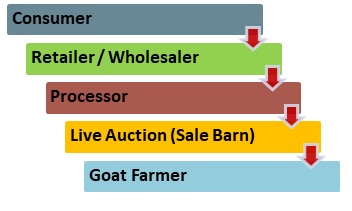
Marketing methods for meat goats include:
- Live auction
- Direct to processor
- Direct to the consumer (farm gate, farmers’ market, online, etc.)
- Direct to the retailer (restaurant, grocery store, etc.)
- Sell breeding stock
- Sell to a feedlot
- Develop and participate in a value chain group
With this list in mind, it is essential to weigh the advantages and disadvantages for each marketing method. Factors to take into consideration include; time devoted to marketing, distance to market, transportation options, trucking costs, other costs such as advertising (if selling direct), payment method and risk to name a few. Some highlights and items to think about are presented in the most common meat marketing methods below.
Live Auction (Sale Barn)
In the Ontario goat industry, live auction is the most common marketing method utilized. Selling through a live auction can be a good option for marketing quality meat goat kids. Typically, the volumes of meat kids coming through the sale barns are low and the demand for goat kids is high. A live auction sale is easy in terms of marketing as there are usually sales every week of the year where the animals are transported to the live auction and sold. The major risk with this method is the unknown price received per animal. When shipping animals it can be beneficial to try and market several times throughout the year to receive an average price overall rather than the extreme high or low prices.
Depending on your location in the province, a list of licensed livestock auction markets can be found at OMAFRA’s Meat Inspection Site.
Direct to Processor
There may be opportunities to partner with a processor or have an agreement with the processor to directly supply goat kids to the facility. If an agreement can be reached between the farmer and processor, this marketing method can be a good option as the goat farmer will know the price in advance, date of shipping and the number to be marketed. This marketing method requires consistent communication between the farmer and the processor. It can be time consuming to ensure an agreement can be reached between both parties.
A list of abattoirs can be found below:
Direct to Consumer or Retailer
Marketing direct to either the consumer or the retailer can be very time consuming and can be costly. Pricing product accordingly is the key to making a profit. Consideration should be given to pricing the product either by the kilogram / pound, by the cut or a flat rate per carcass. Price out chevon in several different ways and compare to the live price at the live auction.
The price should reflect items such as:
- Advertising
- Marketing (i.e. logo, stickers for the product, banners, etc.)
- Transportation
- Processing fees
- Cut and wrap fees
- Farmer’s market stand fees
- Labour spent selling product & marketing
- Equipment needed (i.e. such items as a tent, freezer, etc.)
- Payment options such as investing in a credit card machine or device for a smart phone
- On-farm store costs
- Utilities and depreciation on equipment and vehicles
- Cost of raising the animal
- Other considerations
For more information, OMAFRA has a cost of meat processing tool, an Excel sheet which allows an individual to calculate the cost of meat processing. An example of the tool can be found in Figure 2. The full tool can be found at OMAFRA’s website.

Selling directly to the consumer or retailer can be very rewarding if the individual enjoys talking to the public about the farming operation. Selling direct is a great way to produce a value-added product especially with a smaller herd.
When selling direct to consumer or retailer, any meat or meat product sold or distributed in Ontario must come from inspected sources. These sources include a provincially licensed meat plant (abattoir or free standing meat plant), a federally registered facility or other approved imported sources. The sale or distribution of uninspected meat is illegal. For more details, please refer to the OMAFRA Factsheets entitled, ‘Ontario’s Meat Inspection System’ and ‘Your Responsibilities Under the Meat Regulation’.
For more information on direct farm marketing please refer to the following OMAFRA factsheets: