From March to August 2022 an on-farm project examining artificial rearing systems specifically focused on milk machines and lamb performance was conducted on several Ontario farms. The project had three main objectives: lamb productivity, rearing cost, and producer labour. Six farms participated in the project. Two farms had Lac-Tek milk machines and four farms had Eco Feeders also commonly known as Förster-Technik and / or Grober.
The results will be presented in a series of articles; this article will focus on producer labour. A previous article can be found in the December 2022 Ontario Sheep News for context as well as information on farm specific set-ups, machine cleaning and milk replacer cost.
Producer Labour
Labour was the most variable factor on-farm due to different systems. In the project, trail cameras were set up to track on-farm labour related to the milk machine.
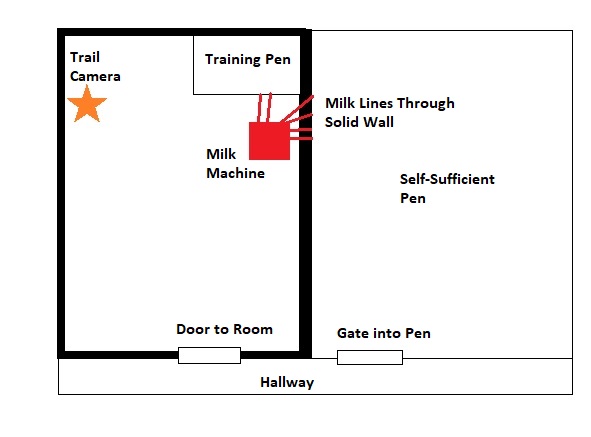
Four farms had a one-room milk machine system, the trail camera was able to be placed and all jobs related to the milk room were able to be recorded. See Figure 1A for an example system. Two farms had a split-room milk machine system, where one room housed the lambs, and a separate room housed the milk machine. Since there was only one trail camera available for each farm, not all of the labour data could be captured. Figure 1B is an example of a split-room situation where the milk machine and training pen were in one room and the self-sufficient pen of lambs was in another room. In this case, the trail camera was placed to view the milk machine and training pen. For Farm 4 and Farm 5, the overall producer time spent in the milk machine room is underestimated due to the split-rooms.
Over the course of the project, some of the trail cameras malfunctioned due to dead batteries, memory card issues or the trail camera getting washed too often. In these cases, the overall producer time spent in the milk machine room is underestimated.
Figure 1A: A one-room milk machine system

Figure 1B: A split-room milk machine system
An example of a typical trail camera picture taken from one farm with a one-room system can be seen in Figure 2, where the milk machine is in the warm room on the right. When the producer cleaned the machine or checked it, the door would be open, and it was easy to see and record their actions. Pictures were examined to record jobs in the room. Labour-intensive jobs included cleaning the machine, training lambs, pen clean out, etc.
Figure 2: A picture taken from the trail camera showing the one-room milk machine system

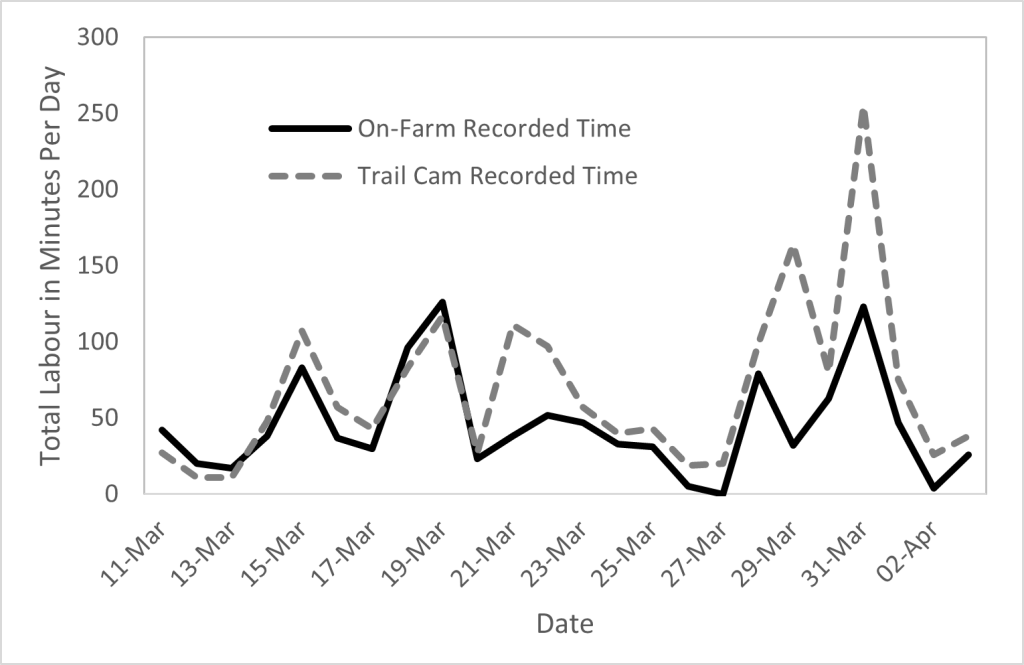
As part of the project, one farm tracked the time spent in the system manually on a clipboard and a trail camera was also placed in the room to compare the two time tracking systems. The comparison of the on-farm recorded time versus the trail camera recorded time can be found in Figure 3. The comparison ran from March 11 to April 3, 2022. The total on-farm recorded time was 18 hours and the total trail camera recorded time was 28 hours. There was a difference of 9 hours or $188 more in labour costs captured on the trail camera versus the on-farm recorded time. Some of the larger spikes in the graph captured by the trail camera but not by the producer included medicating lambs and pen clean outs. This shows that typically on-farm labour is underestimated by producers, and small jobs can add up over time.
Figure 3: Labour per day spent in the milk machine system in minutes: farm 1
Trail camera footage was compiled on all six farms to calculate labour costs. The total number of lambs that were added to the milk machine, the average time spent in minutes per day and the labour cost per day on the milk machine lambs is reported in Table 1. The average time spent in the artificial rearing system was 42 minutes per day while the average labour cost was $14 per day across the six farms. The labour rate was based on $20 per hour.
Table 1: Average time and labour cost spent per day with the artificial rearing system
| Farm 1 | Farm 2: Group A | Farm 2: Group B | Farm 3 | Farm 4 | Farm 5 | Farm 6 | |
| Total # of lambs to milk machine | 105 | 125 | 60 | 18 | 85 | 13 | 13 |
| Average time spent per day in the artificial rearing system (minutes / day) | 69 | 93 | 26 | 35 | 40 | 19 | 10 |
| Labour cost / day ($) * | $23 | $31 | $8.77 | $11.63 | $13.43 | $6.23 | $3.36 |
The total number of lambs on the milk machine, total time spent per live lamb from start to weaning in minutes and the total labour cost spent per live lamb is shown in Table 2. The total time spent in the system from start to weaning across the six farms on average was 26 minutes per live lamb, while the total labour cost was $9 per live lamb.
Table 2: Total time and labour cost spent per live lamb from entry to weaning in the artificial rearing system
| Farm 1 | Farm 2: Group 1 | Farm 2: Group 2 | Farm 3 | Farm 4 | Farm 5 | Farm 6 | |
| Total # of lambs to milk machine | 105 | 125 | 60 | 18 | 85 | 13 | 13 |
| Total time spent / live lamb from start to weaning (minutes) | 22 | 37 | 10 | 15 | 19 | 45 | 37 |
| Labour Cost / Live Lamb ($)* | $7.45 | $12.27 | $3.31 | $5.09 | $6.37 | $15.07 | $12.33 |
In general, a higher number of lambs on the machine meant that the average time spent in the artificial rearing system per day and labour cost per day were higher than the systems with less lambs. However, the farms with more lambs on the system had a lower overall labour cost per live lamb. This can be seen in Figure 4. In the figure, the number of live lambs raised on the machine are in brackets above the labour cost per live lamb.
When using a milk machine in general, there are ‘sunk’ labour duties such as machine cleaning, pen clean out and repairs which happen regardless of the number of lambs on the machine.
Figure 4: Comparison between the labour cost per day versus the labour cost per live lamb across the six farms
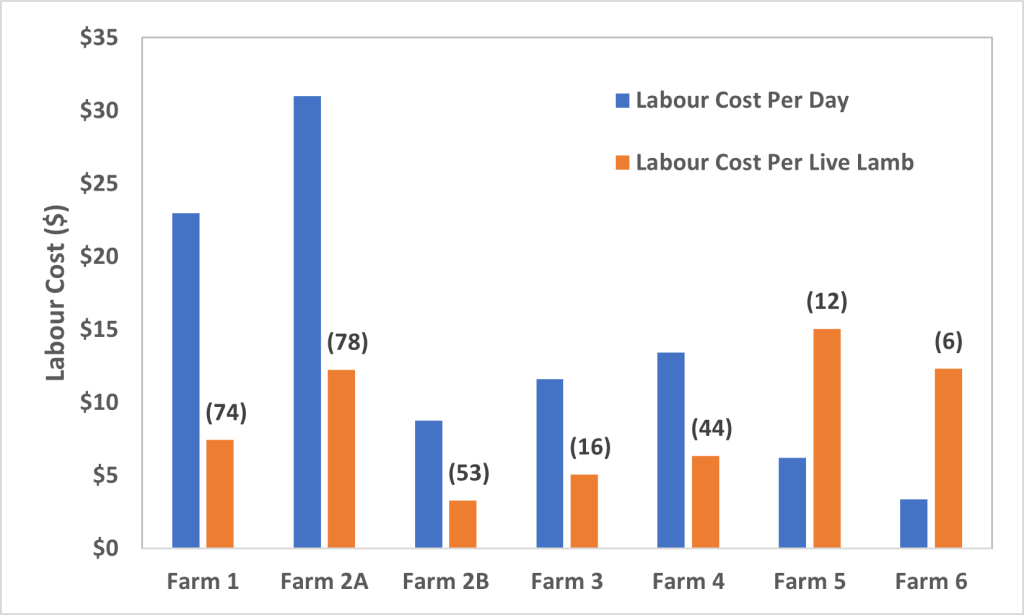
(#) – number in brackets represents the number of live lambs raised on the machine
*Labour based on $20 per hour
Other labour findings
Four farms fully cleaned the machines regularly, either every day or every other day depending on the weather, number of lambs on the machine and work schedules. Two farms had Lac-Tek machines and spent 20 minutes and 20.3 minutes respectively cleaning the machines. The other two farms had Eco Feeders also commonly known as Förster-Technik and / or Grober machines. On these farms, producers spent on average 21 minutes and 17.7 minutes respectively on full machine cleans. The four farms had similar cleaning protocols. The farm that took 17.7 minutes to clean the machine, did not have as many milk lines as the other farms which led to the reduction in overall cleaning time. For cleaning recommendations please refer to Part 1 of the article series.
Pen clean outs and other jobs varied on farms due to different set-ups and systems. Two farms operated on a slatted floor system while the other four had straw or straw / shavings bedding system. The pen clean out time also varied based on the total area in the artificial rearing system and stocking density of the lambs. These numbers have not been reported due to the huge variability.
Observations / Key Findings
Labour was the most variable factor on-farm due to different systems. When using a milk machine or artificial rearing system in general, there are ‘sunk’ labour duties such as machine cleaning, pen clean out and repairs which happen regardless of the number of lambs on the machine.
- In general, as the number of lambs increased in the system, the labour cost per lamb decreased. The average labour cost per day spent on the artificial rearing system was $14 across the six farms. While the average labour cost per live lamb from the time they went on the milk machine to weaning was $9 across the six farms.
- As stated previously, the labour values are underestimated due to either trail camera failures for certain days or split-room milk machine systems on two of the six farms.
- Labour per day should not necessarily be reduced dramatically as machine cleaning and lamb observation / management was an important factor to weaning healthy lambs off of the milk machine.
Thank you to the six farms who participated in the on-farm study. Your participation is greatly appreciated and allowed us to collect some meaningful benchmarks for lambs raised artificially on milk machines.