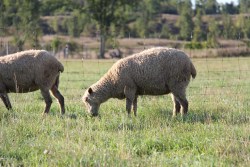
This list details actions Ontario farmers could take to increase feed inventory before, during, and after prolonged hot and dry conditions.
This list details actions Ontario farmers could take to increase feed inventory before, during, and after prolonged hot and dry conditions.
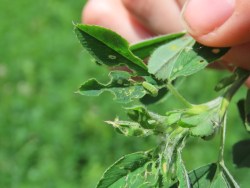
Alfalfa weevil is a major alfalfa pest in Ontario. Larvae feeding on alfalfa leaves can reduce both yield and forage quality. The simple answer As alfalfa gets taller it can tolerate more weevils before action is necessary to protect forage yield and quality. Action thresholds for managing alfalfa weevil are as follows: Stem Height Number of larvae per stem Up to 30 cm (12 in.) More than 1 Up to 40 cm (16 in.) 2 or more Any height More than 3 A little more information Alfalfa weevil larvae begin feeding in mid- to late-May, beginning with the leaf buds. The larvae then move to leaves near the stem tips, where damage starts off as pinholes (Figure 1) and progresses…
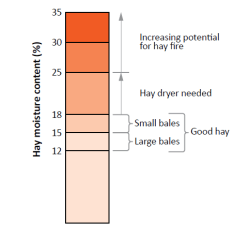
Key Points: What Causes Fires? The process of forage heating up and then burning is typically called spontaneous combustion. Spontaneous combustion for hay usually occurs within the first two months of storage. Unusual growing conditions, such as an early harvest window or immature crop, can complicate the drying process and increase the risk of fire. Spontaneous heating and combustion occur when sufficient moisture (above 25% and below 45% moisture content for forages), oxygen (air) and organic matter are present together to support the growth of bacteria and moulds. This growth results in an initial temperature peak of 54°C–65°C. When the forage reaches this temperature range, a chemical process called the Maillard Reaction may occur, causing additional heat generation. This reaction…
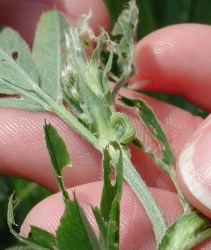
This article was originally written by Joel Bagg in 2013. It was edited May 1st, 2023 by Christine O’Reilly to reflect current insecticide options to control alfalfa weevil. Alfalfa weevil can be an issue in Ontario, particularly in south-western parts of the province. While outbreaks tend to be isolated, they can be severe and dramatically reduce forage yield and quality. Typically, alfalfa weevil do not reach significant levels until we are ready to take first-cut. However, sometimes alfalfa weevil larvae development is advanced relative to the alfalfa crop, and can do significant damage before the crop is ready to cut. Control options are to cut early or spray. Insecticides are recommended only when cutting is impractical, such as when the…

Description Blister beetles are very rare in Ontario but have been occasionally found in alfalfa fields north of Lake Erie. They are more common in arid climates, such as the U.S. Midwest, and are often associated with grasshopper infestations. The three most common species are the black blister beetle (Epicauta pensylvanica), the ash grey blister beetle (Epicauta fabricii) and the striped blister beetle (Epicauta vittata). Blister beetles have soft bodies 1–2.5 cm (3/8 –1 in.) long. The thorax between their head and abdomen is long and narrow, making it look like a neck. Their wings tend to be shorter than their abdomen. The black and ash-grey blister beetles are solidly coloured as their names describe (Figures 1 and 2). The…

Many management decisions affect hay quality. After deciding when to cut, the next big decision is about the moisture content. Accurately timing how long to let the crop wilt when harvesting a forage crop will help ensure that it stores well. It either needs to have enough moisture to ferment correctly (silage/haylage or baleage systems), or low enough moisture content to preserve as dry hay. There are three types of moisture to consider when wilting a forage crop: stem moisture, dew moisture, and air humidity. Stem moisture is the amount of water within the plant. Dew moisture is water outside the plant, whether it is from rain or condensation (dew). Air humidity affects how quickly the crop can dry. If…

Grass doesn’t just happen and not all species grow the same way. Understanding how different grass species grow enables producers to make good management decisions that maximize forage production in their hay fields and pastures. Jointing and non-jointing grasses respond differently to cutting, which directly affects productivity and persistence. In an established stand, grass plants are not made up of a single stem but have many tillers. One grass plant may have dozens of tillers which arise from growing points at the base of the plant. Having the growing point at the base of the plant is an evolutionary adaptation because it protects the grass from grazing, since most animals cannot graze so close to the ground as to damage…

Good agronomy is very important for achieving good yield and quality in forage crops. While good agronomy includes a fertility plan, seeding techniques, and harvest management, it also relies on proactive decision-making. The only way to know what is happening in a field before it is too late is to scout. Taking regular walks through hay fields and observing them carefully is important throughout the growing season, however, there are some special things producers should assess when scouting in the early spring. At green-up When the crop has broken dormancy and is putting out new buds, it is time to do a plant count and root health assessment to determine how well the alfalfa overwintered. This first scouting is a…

Fall and Winter Conditions Rain delays in 2017 pushed harvest in some areas into the critical fall harvest period. Root reserves that contribute to winter hardiness and promote spring growth were reduced. Many fields across the province were harvested when soils were still wet from frequent rainfall. Soil compaction in forage fields was a silent yield thief in 2018; research has shown compaction can reduce yields between 6-75% in grass stands. Winter conditions were equally challenging: across the province, several freeze-thaw cycles occurred between January and April. While agronomists report most of the province experienced less alfalfa winter-kill than expected, northeastern Ontario had severe winter-kill in alfalfa and grasses. Winter injury was most common in low-lying areas, heavy-textured soils, and…
The Production Insurance Forage Rainfall Program may be a good fit for you. The forage rainfall plan uses rainfall as an indicator of quantity and quality of forage. There are two coverage options available: •Insufficient rainfall •Excess rainfall Insufficient Rainfall The insufficient rainfall option protects against insufficient rainfall only. If the measured rainfall at the station you choose during the insured period is less than 85 per cent of the long-term average rainfall for your area, a claim may be paid. The producer can chose the rainfall collection station data to use. Excess Rainfall The excess rainfall option provides protection against excess rainfall during the chosen harvest period. The producer selects a rainfall threshold of 5 mm or 7 mm. If you…