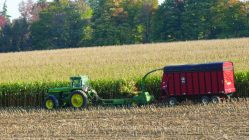
Forage Options to Replace Silage Corn

Forage Options to Replace Silage Corn

Key Points: Why replace silage corn? Some regions in Ontario have observed high corn rootworm pressure in 2020 that is challenging current Bt rootworm hybrids. In regions where Bt rootworm corn hybrids have been used for more than three consecutive years, resistance among corn rootworm populations is suspected. Several growers in Ontario are reporting fields with rootworm injury to trait providers and research and extension scientists. Growers in areas with resistant rootworm populations can no longer rely solely on Bt rootworm hybrids for protection against rootworm injury. Continued use of these hybrids in problem fields can perpetuate the issue, allowing resistant populations to survive and spread to neighbouring fields. Other control measures like granular insecticides or seed treatments can only…

Feeding Corn Silage to Sheep

Corn silage is quickly becoming an economical and viable feedstuff for sheep as grain prices continue to rise and sheep flocks are becoming larger and more mechanized. Corn silage is unique due to rapid harvesting ability, low-cost storage and high yields of forage per hectare. It is a high-energy feed with a grain content of 40% or more. OMAFRA’s new factsheet Feeding Corn Silage to Sheep explains how with proper equipment, management and ration formulation, corn silage can be effectively fed to both the ewe flock and market lambs.

Frost-Damaged Corn Silage

This article was originally posted on Field Crop News Written by Joel Bagg. Late planting dates, low Crop Heat Unit (CHU) accumulations, and early frost may result in situations where corn is killed by frost before it reaches the normal stage of maturity and moisture for silage. Some fields planted for grain may not mature adequately for optimum yield, moisture and quality. Farmers may be looking at salvaging these crops by harvesting or selling some of those fields for silage.  The key to making the most of frost-damaged corn silage is to harvest it at the correct moisture. Nutrient Quality Slightly immature, frost damaged corn that has dented can make good silage. Energy is partitioned differently in immature silage than…

Harvesting Corn Silage At the Right Moisture

This article was originally posted on Field Crop News Written by Joel Bagg. The importance of harvest moisture and maturity to corn silage quality and animal performance is often underestimated. Not only is it important to minimize fermentation dry matter and spoilage losses, it is difficult to compensate for poor forage quality in ration balancing and animal performance. Don’t get caught harvesting corn silage outside the range of optimum moisture and maturity. In areas that are extremely dry, optimum moisture may occur before optimum maturity. Focus on harvesting at the correct moisture. Importance of Correct Moisture Ensiling at the correct whole plant moisture and optimum stage of maturity is critical. Corn maturity is very dynamic. As corn matures from dent to…