Key Points: What Causes Fires? The process of forage heating up and then burning is typically called spontaneous combustion. In silos, forage can dry down if air enters the silo through leaks in walls or doors; this results in the potential for fires throughout the whole year. Spontaneous heating and combustion occur when sufficient moisture (above 25% and below 45% moisture content for forages), oxygen (air) and organic matter are present together to support the growth of bacteria and moulds. This growth results in an initial temperature peak of 54°C–65°C. When the forage reaches this temperature range, a chemical process called the Maillard Reaction may occur, causing additional heat generation. This reaction can be self-sustaining and does not require oxygen…
All posts in Forage
New! Publication 30: Guide to Forage Production
Publication 30: Guide to Forage Production is a comprehensive guide to forage agronomy. It has information on establishment, fertility, weed management and weather stress for many species grown as forage in Ontario. It also covers harvest and storage of forage crops and understanding a laboratory forage analysis. To download a free PDF version or order a paper copy, click here. ~~~~~~ La Publication 30F, Guide de production fourragère, constitue une source de renseignements détaillés sur les pratiques agronomiques en production fourragère. On y trouve de l’information sur l’établissement, la fertilité, la lutte contre les mauvaises herbes et le stress thermique, applicables à de nombreuses espèces végétales cultivées comme plantes fourragères en Ontario. Ce Guide traite aussi de questions concernant la récolte et l’entreposage des fourrages et…
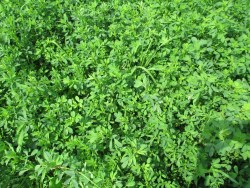
Is the yield potential of alfalfa increasing?
The relationship between alfalfa breeding efforts and yield potential is complicated. While most literature on annual grain crops shows yield improvements with the release of new varieties over time, a literature search on alfalfa yield will show improvement, stagnation, and declines, depending on the paper. One of the latest attempts to discern what is really going on comes from Lei Ren and colleagues out of the University of Saskatchewan. Ren and colleagues summarized data from the Western Forage Variety Testing System from 1997 to 2011 to see how breeding has changed the yield potential of alfalfa varieties over time. They recognized that environmental conditions and harvest management are factors that can affect alfalfa yield that are not always included in…

Grass Growth Rates and Pasture Management
Pasture managers can determine the minimum grass growth rate required to feed their flock. Producers who track grass growth rates and compare them to their minimum required rate can make proactive management decisions to avoid running out of pasture.

Blister Beetles
Description Blister beetles are very rare in Ontario but have been occasionally found in alfalfa fields north of Lake Erie. They are more common in arid climates, such as the U.S. Midwest, and are often associated with grasshopper infestations. The three most common species are the black blister beetle (Epicauta pensylvanica), the ash grey blister beetle (Epicauta fabricii) and the striped blister beetle (Epicauta vittata). Blister beetles have soft bodies 1–2.5 cm (3/8 –1 in.) long. The thorax between their head and abdomen is long and narrow, making it look like a neck. Their wings tend to be shorter than their abdomen. The black and ash-grey blister beetles are solidly coloured as their names describe (Figures 1 and 2). The…
How do I repair pugged pasture?
Pugging is sod damage and soil compaction caused by livestock hooves. Prevent pugging by moving livestock to a barn, dry lot, or sacrifice paddock. Assess the severity of pugging to determine the most appropriate repair options. Timely repairs maintain pasture yield and keep weeds out.
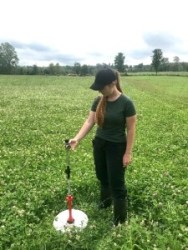
Using a Rising Plate Meter as a Tool to Improve Pasture Management: Summer Project 2021
The author of this article is Mary O’Connor, an OMAFRA summer student who, under the supervision of James Byrne (OMAFRA Beef Cattle Specialist), assisted with this project. The article was first published in the October 2021 edition of Virtual Beef. Introduction In Canada, grazing land, consisting of natural and planted pastures, accounts for approximately 50 million acres (Statistics Canada, 2011). Pastures provide numerous benefits to the producer, animals, and the surrounding environment. Grazing livestock on pasture provides economic benefits to the producer by supplying nutritious low-cost feed for livestock and utilizing marginal land not suitable for crop production (OMAFRA, 2015). Measuring and monitoring pasture growth on a regular basis can improve pasture performance, pasture productivity and livestock performance. A rising plate…
Grazing Livestock and Forage Palatability: How They Go Hand in Hand
This article was written by Breann Saulnier, OMAFRA Grazing Livestock Assistant. You may look out into a pasture and see an abundance of tall, delicious-looking grass for livestock to graze but this is not necessarily what the livestock see. The amount of forage available for grazing is the portion of plant material that the animal chooses to eat, not the total amount of forage growing that is visible. So how do you know what the animal will choose to eat? Well, the palatability and the utilization of forage for animals is influenced by what stage of growth the grass is in. In the context of grazing, palatability refers to a measure of when animals are given free choice, choose to…

Moisture Content and the Hay Drying Curve
Many management decisions affect hay quality. After deciding when to cut, the next big decision is about the moisture content. Accurately timing how long to let the crop wilt when harvesting a forage crop will help ensure that it stores well. It either needs to have enough moisture to ferment correctly (silage/haylage or baleage systems), or low enough moisture content to preserve as dry hay. There are three types of moisture to consider when wilting a forage crop: stem moisture, dew moisture, and air humidity. Stem moisture is the amount of water within the plant. Dew moisture is water outside the plant, whether it is from rain or condensation (dew). Air humidity affects how quickly the crop can dry. If…

Managing Jointing and Non-jointing Grasses
Grass doesn’t just happen and not all species grow the same way. Understanding how different grass species grow enables producers to make good management decisions that maximize forage production in their hay fields and pastures. Jointing and non-jointing grasses respond differently to cutting, which directly affects productivity and persistence. In an established stand, grass plants are not made up of a single stem but have many tillers. One grass plant may have dozens of tillers which arise from growing points at the base of the plant. Having the growing point at the base of the plant is an evolutionary adaptation because it protects the grass from grazing, since most animals cannot graze so close to the ground as to damage…