



This article was written by Kristy Blankers and Delma Kennedy
Introduction
Animal efficiency is important to a livestock farm’s bottom line. Therefore, it is beneficial to select for animals that are able to wean more kilograms of lamb per kilogram of mature body weight. Animal performance is influenced by a ewe’s body condition score (BCS) and body weight. To effectively select animals that are more efficient, body weight and BCS must be taken into consideration.
Over the past four years, BCS, body weight, and performance data has been collected on farm with the objective of being able to create a genetic evaluation model to select animals that can maximize production per kilogram of mature body weight. With three breeding seasons per year, Winter (January), Spring (June) and Fall (October/November), the data set includes 13 breeding seasons starting at the Fall 2020 breeding group to the Fall 2024 breeding group. This article reports some results from the preliminary analysis of the data.
Results
Liveweight by BCS
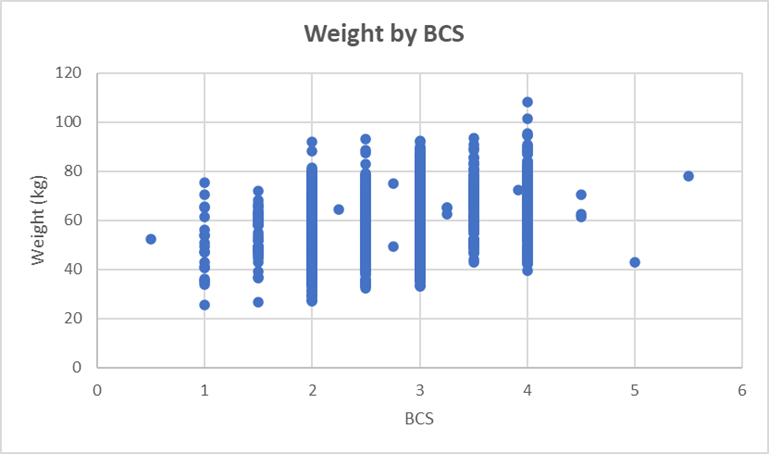
As shown in figure 1, there is a large range of liveweights for each BCS, with a general trend of fatter animals being heavier.

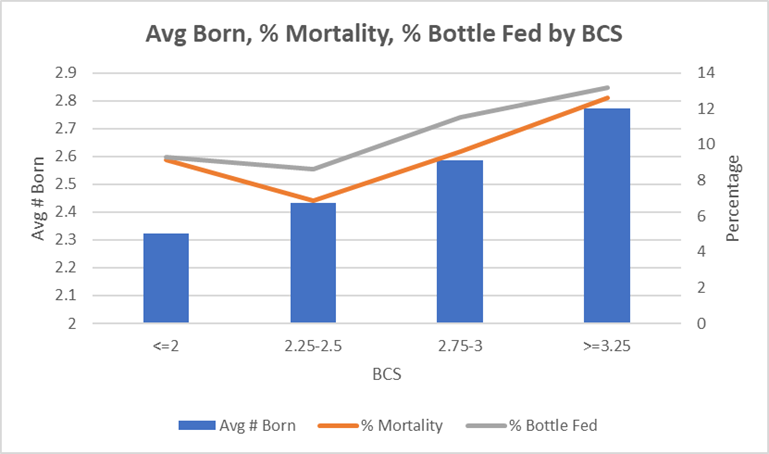
Average Number Born, Percent Mortality, and Percent Bottle Fed by BCS
Figure 2 shows the average number of lambs born, precent mortality and percent bottle fed by BCS. The average number of lambs born is affected by a ewe’s BCS, with more lambs being born from ewes with a higher BCS. The percent mortality and percent bottle fed increase as the average number of lambs born increases. This is expected as it is much harder for an ewe to raise litters of triplets or more.
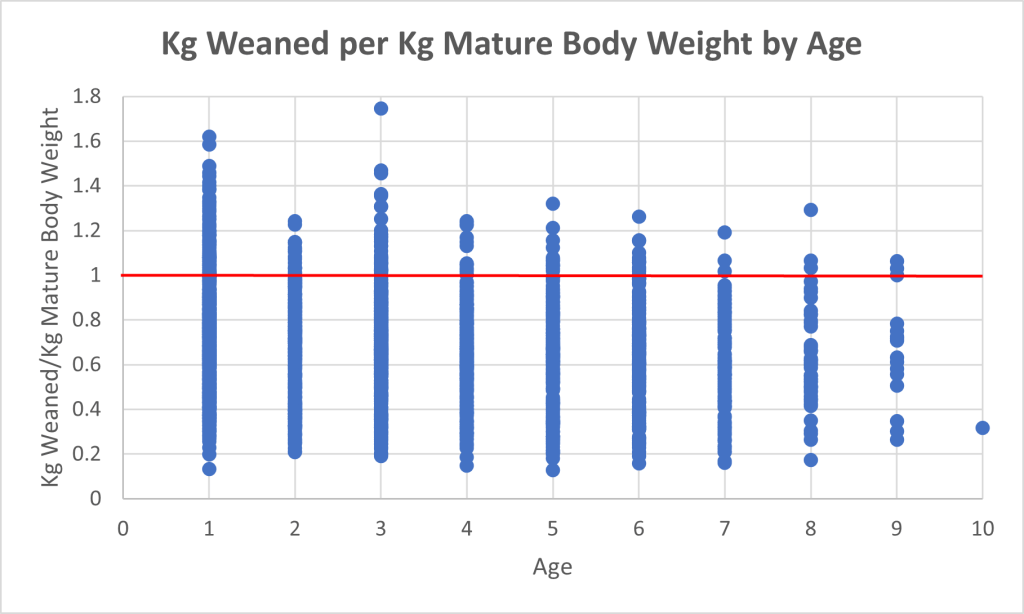
Kilograms Weaned per Kilogram of Mature Body Weight by Age
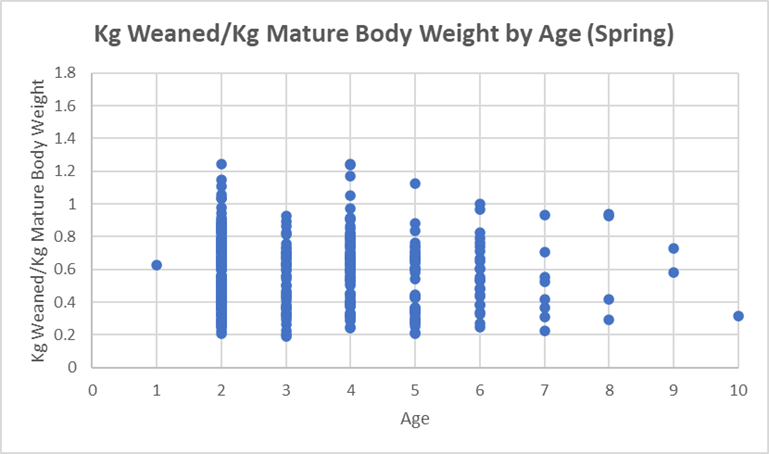
Figure 3 shows kilograms weaned per kilogram of mature body weight by age for all the breeding groups combined. Kilograms weaned per kilogram mature body weight is a performance measure that could be used for selection. The red line on the graph is an ewe that can wean her weight in lambs. This graph demonstrates that there are ewes whose performance is much better than others. There is a general trend of performance decreasing with age of ewe.

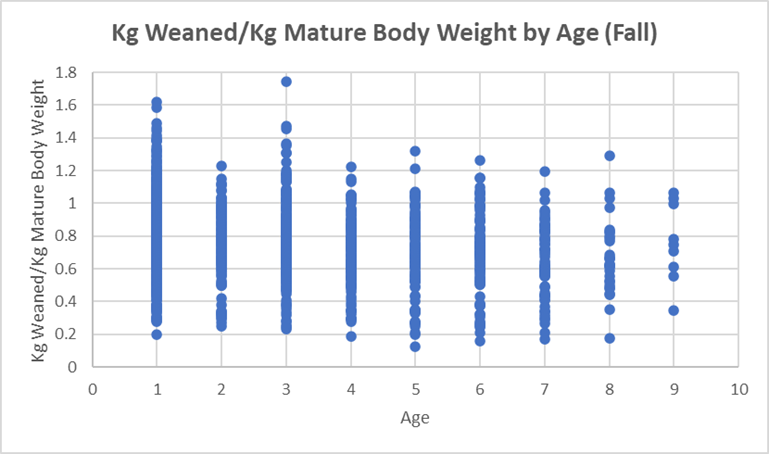
Performance is also influenced by season. Sheep bred during the Fall breeding season (Figure 4) have higher performance (kilograms weaned per kilogram mature body weight) compared to animals bred during the Spring breeding season (Figure 5).
Conclusion
Animal performance and efficiency is influenced by various factors such as BCS, age and season. This data illustrates that there is potential to increase the average efficiency of ewes. The large range in performance at different ages and body condition score in different seasons under the same management means that there is a genetic component that could be selected. To do this more accurately, the data would need to be analyzed by a genetic selection program such as GenOvis to properly account for things like body condition score, age and season. In the meantime producers could use average ewe weight at breeding and average lifetime weight weaned per lambing to determine the range of performance in their flock and compare the efficiency of their mature ewes.