


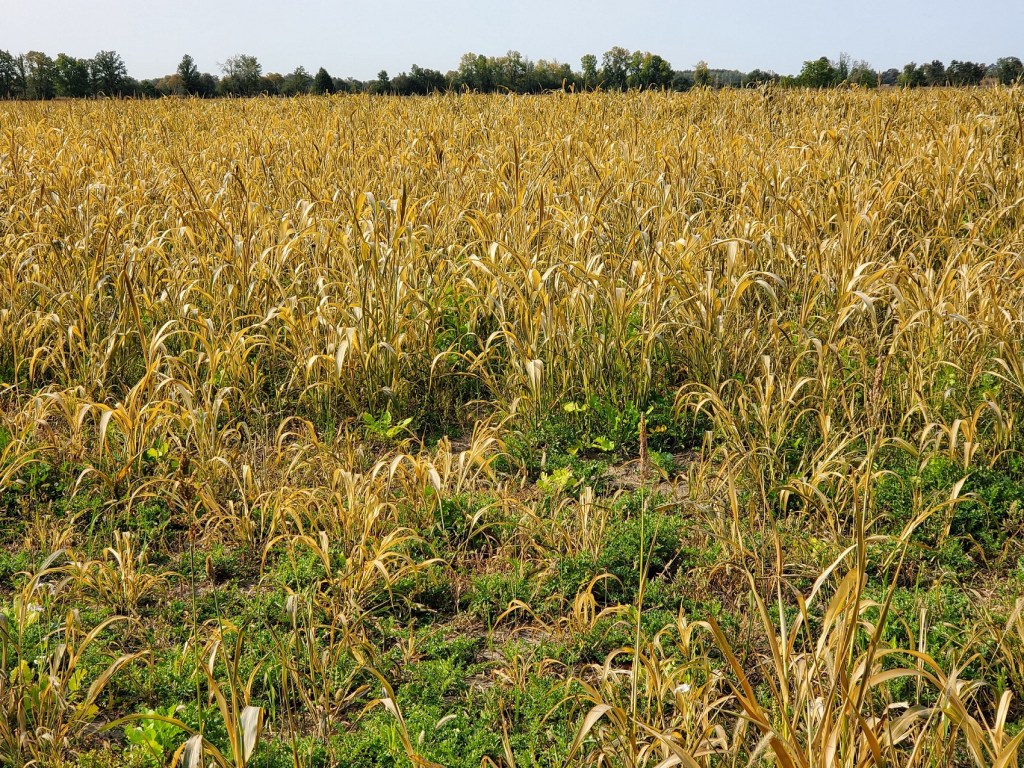
Photo: It is impossible to tell by looking at frost-damaged sorghum-sudangrass what the prussic acid levels may be.
Silage Corn
In fields where rootworm Bt hybrids have been used for three or more consecutive years, resistance among corn rootworm populations is suspected. Producers can no longer rely solely on Bt rootworm hybrids for protection against rootworm injury. See the 2020 Canadian Bt Corn Trait Table for more information on which traits are present in your hybrid.
The best management practice to reduce the resistant rootworm population is to rotate out of corn for at least one year. Producers are encouraged to replace corn for a minimum of one year, but ideally for the next two to three years. To replace silage corn for 2021, establish fall rye or winter triticale immediately after 2020 silage corn harvest. After the cereal silage comes off in mid-May, establish sorghum-sudangrass and take two cuts. An energy source will need to be supplemented; producers should consult their nutritionist to correctly balance the ration. More details on how to double crop a winter cereal and sorghum-sudangrass are available in Forage Options to Replace Silage Corn.
Data from the 2020 Grain Corn Ear Mould and Deoxynivalenol (DON) Mycotoxin Survey is being processed. Results will be posted on FieldCropNews.com when available.

Southwest
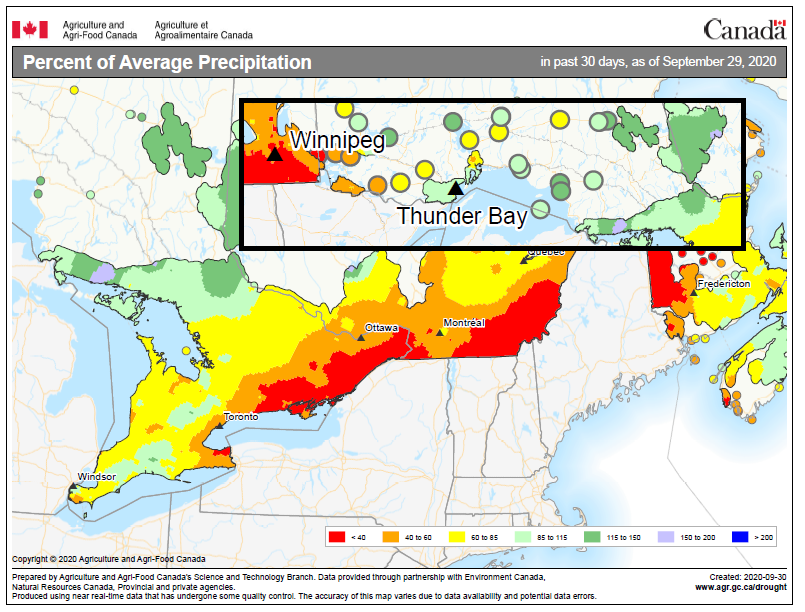
- Agriculture and Agri-Food Canada report that most of the region received below-average precipitation for September. Parts of Chatham-Kent, Lambton, Elgin, Middlesex, Norfolk, Oxford, York, Peel, and Wellington counties received average amounts of rainfall for the month (Figure 1).
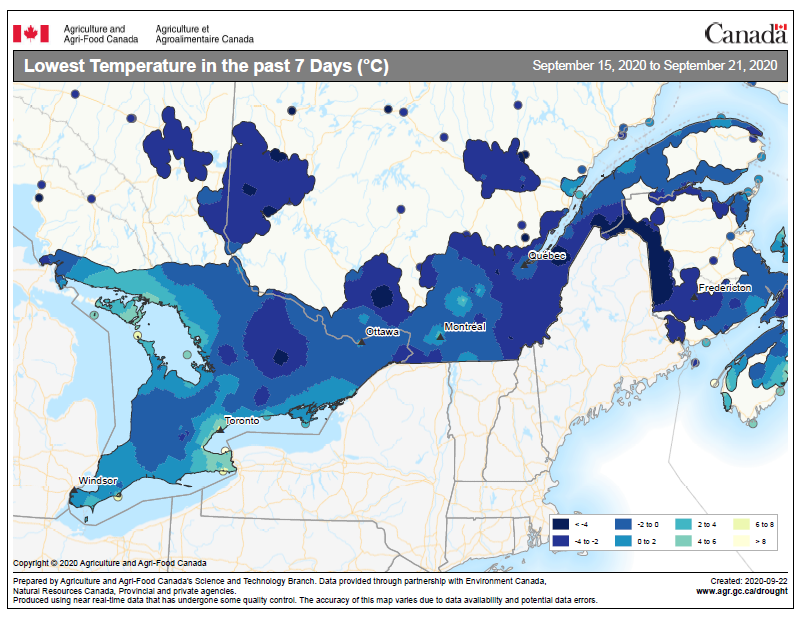
- The first frost occurred in many parts of the region during the week of September 15-21 (Figure 2). The highest risk for prussic acid issues in sorghum species is between the first frost and the first killing frost. Producers should wait to graze or harvest sorghum crops affected by frost until after a killing frost to minimize risk.
- Reports from the field indicate silage corn yields are good, except in very dry areas where they are below normal.
Central and East
- According to Agriculture and Agri-Food Canada, this region received below-average rainfall for September (Figure 1).
- The first frost occurred in many parts of the region during the week of September 15-21 (Figure 2). The highest risk for prussic acid issues in sorghum species is between the first frost and the first killing frost. Producers should wait to graze or harvest sorghum crops affected by frost until after a killing frost to minimize risk.

Northeast
- Agriculture and Agri-Food Canada report that Manitoulin, Timiskaming, and Sudbury districts received average precipitation for September, along with parts of Algoma, Parry Sound, and Nipissing. The rest of the region received above-average rainfall for the month (Figure 1).
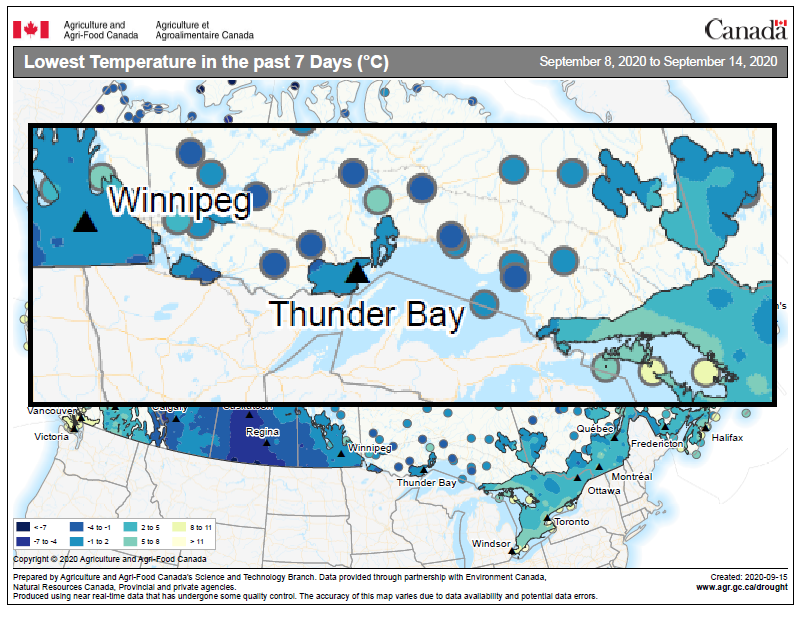
- The first frost occurred in many parts of the region during the week of September 8-14 (Figure 3).
Northwest
- According to Agriculture and Agri-Food Canada, Thunder Bay District received average rainfall for September, while Rainy River and Kenora districts had below-average amounts of rainfall (Figure 1).
- The first frost occurred in many parts of the region during the week of September 8-14 (Figure 3).

Upcoming Events
- November 10, 17, & 24: Cover Crop Grazing “Dollars and Sense”. Hear from beef and sheep producers across Ontario about the benefits they’ve realized from grazing cover crops. Free webinars, 7pm EST. Registration required for event link – available soon. Presented by OMAFRA, Beef Farmers of Ontario, and Ontario Sheep Farmers.
- November 18 & 19: Canadian Forage and Grassland Association annual conference “Vision 2020: Growing Forage Opportunities”. Registration $178. Details at https://canadianfga.com/2020/
- December 1-3: Ontario Forage Council presents Forage Focus “Wrap It Up – Harvest, Storage, and Recycling”. Free webinar each day at 1pm EST/noon CST. Registration required for event link. Dec 1 “Baleage, Fail-age and Garbage” with Kendall Guither, farmer. Dec 2 “Post-Plastic Forage Storage” panel discussion. Dec 3 “Hitting the Bullseye on Forage Quality” with John Winchell, Alltech. Details at http://ontarioforagecouncil.com/programs/forage-focus.