This article was originally shown in the Spring 2020 issue of OMAFRA’s Dairy Goat Digest and authored by Mike Eastment, Residue Control Officer, OMAFRA.
OMAFRA’s (Ontario Ministry of Agriculture, Food, and Rural Affairs) meat inspection program uses monitoring and surveillance testing to determine whether chemical residues (e.g., antibiotics) are present in food animals. This testing provides data on a variety of veterinary drugs. Chemical residues in foods are of concern as they have been linked to severe allergic reactions, carcinogenicity and the spread of bacterial resistance to antibiotics used in human medicine.
Goat producers should be aware that there are no approved antibiotics for use in goats in Canada. Therefore, any use is considered extra-label drug use (ELDU). ELDU is defined as¹.
- Administration to a different SPECIES or production class (e.g., lactating versus dry versus weaned) than listed on the label
- Administration of a different DOSE than listed on the label
- Administration of a different VOLUME per injection site than listed on the label
- Administration via a different ROUTE than listed on the label
- Administration at a different INTERVAL (frequency) than listed on the label
- Administration for a different DURATION (length of time) than listed on the label
- Administration for a different INDICATION (purpose) than listed on the lab
In most situations, ELDU will affect milk and meat withdrawal times.
As part of the ministry’s monitoring program, OMAFRA routinely tests tissue and kidney samples from goats slaughtered at provincially licensed plants. Occasionally these tests will come back with an adverse result (e.g., residues above the Health Canada Maximum Residue Limit). Drug withdrawal times for products used in an extra-label manner are based on maximum residue limits (MRLs) and scientific studies; and take into account government testing. If no MRL has been established for a drug in a particular species OR for milk/tissue, then ANY amount detected in milk/tissue constitutes a residue violation. This is one of the reasons why goat withdrawal times are longer than cattle withdrawal times. When adverse results are detected, the Canadian Food Inspection Agency is notified for possible trace back to the farm of origin. Additionally, OMAFRA will communicate adverse drug residue results to individual meat plant operators through written letters and possible visits to the plant.
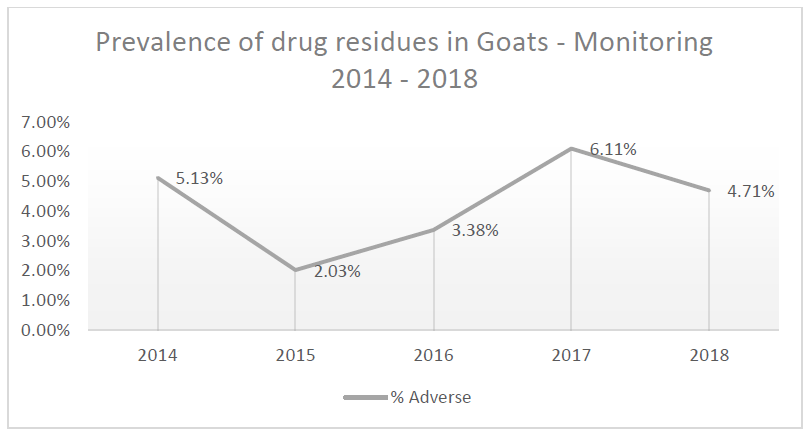
Seen in Figure 1 is a summary of the prevalence of drug residues found in the meat of goats tested under OMAFRA’s monitoring program. The data covers the period 2014 to 2018. Tetracyclines (e.g., oxytetracycline, tetracycline and chlortetracycline) are commonly implicated in goat meat residue violations. Producers are strongly encouraged to discuss withdrawal times with their herd veterinarian.