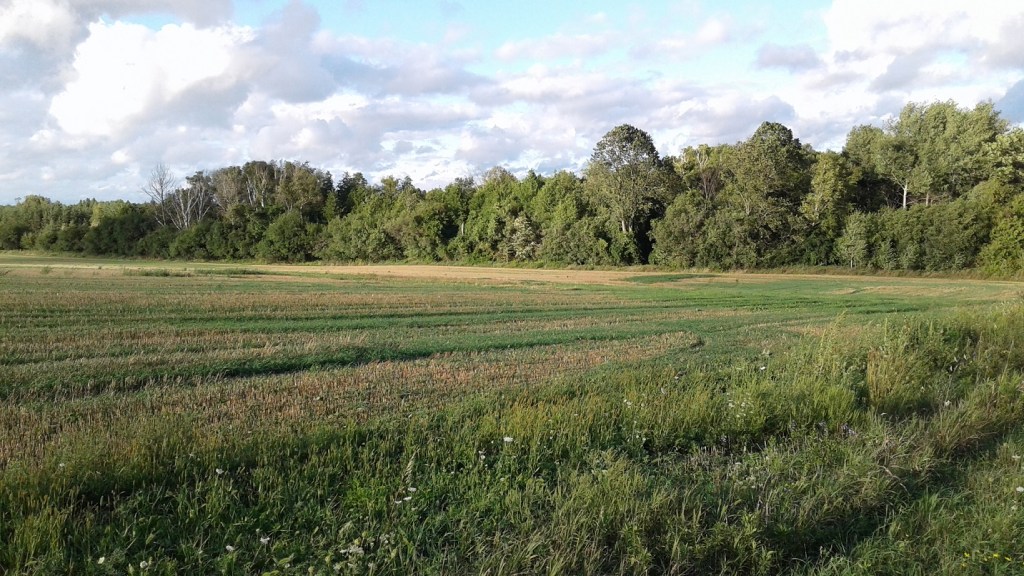
Photo: Many winter wheat fields were planted to an annual forage crop after harvest this year.
Premiums for summer-seeded New Forage Seeding insurance are due to Agricorp September 15.
Silage corn growers should check fields for rootworm resistance to Bt hybrids
Scouting for corn rootworm injury in silage fields is important to detect potential resistance to rootworm Bt traits and to plan management options for the next growing season. It is especially important to report any fields showing signs of suspected resistance to your corn agronomist and the provincial entomologist. High Risk Fields for Resistance to Occur Include:
- continuous corn production
- repeated use of same rootworm Bt trait(s) for multiple years (see the 2020 Canadian Bt Corn Trait Table for more information on which traits are present in your hybrid)
- high CRW beetle population last year where a lot of egg laying likely occurred
Scouting Guidelines to Determine Possible Rootworm Resistance are available on Field Crop News. Scouting should occur in early September, before silage harvest.
Rotating out of corn is the most effective way to reduce Bt-resistant corn rootworm populations. To replace silage corn for 2021, establish fall rye or winter triticale immediately after 2020 silage corn harvest. After the cereal silage comes off in mid-May, establish sorghum-sudangrass and take two cuts. An energy source will need to be supplemented; producers should consult their nutritionist to correctly balance the ration. More details on how to double crop a winter cereal and sorghum-sudangrass are available in Forage Options to Replace Silage Corn.
Southwest
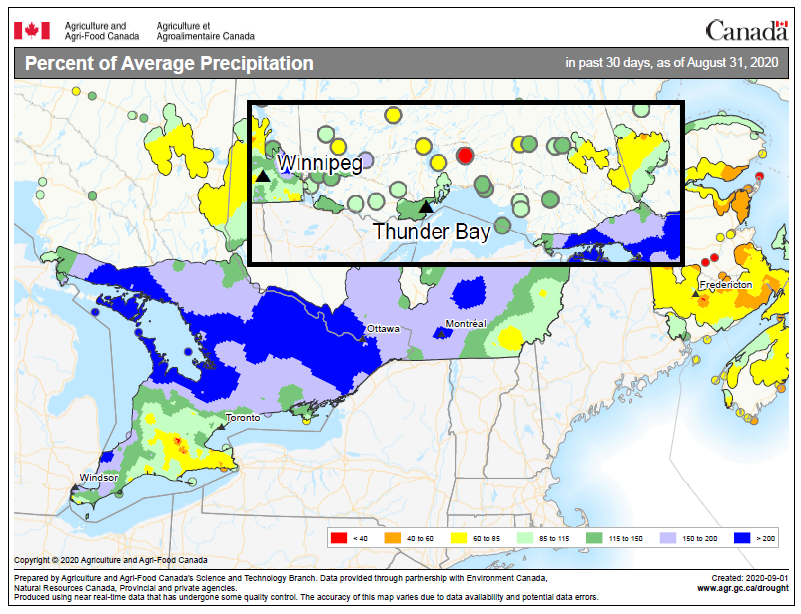
- According to Agriculture and Agri-Food Canada, Niagara, Haldimand, Brant, and Oxford counties received below-average amounts of precipitation in August. The rest of the region received average or above-average rainfall for August. Regrowth on hay fields and pastures was good in those areas receiving above-average rainfall.
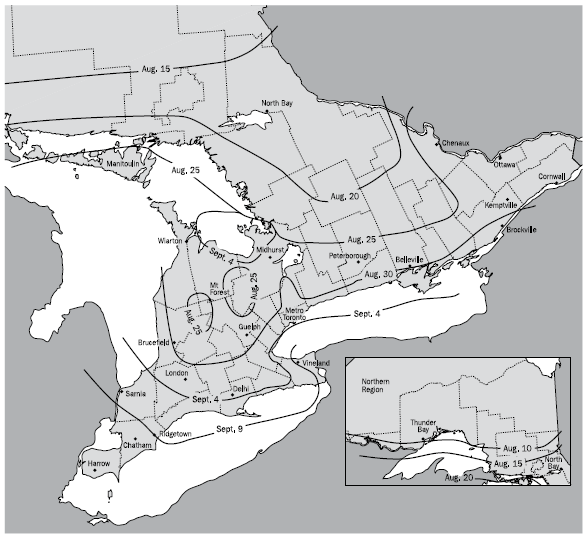
- Most of this region is in the fall rest period for alfalfa. The rest period will start in Lambton, southern parts of Middlesex, Elgin, the southern half of Norfolk, and parts of Haldimand and Niagara on September 4th. The fall rest period will start in Chatham-Kent and Essex on September 9th.
- Reports suggest many acres were seeded to an annual forage crop after winter wheat harvest.
Central and East
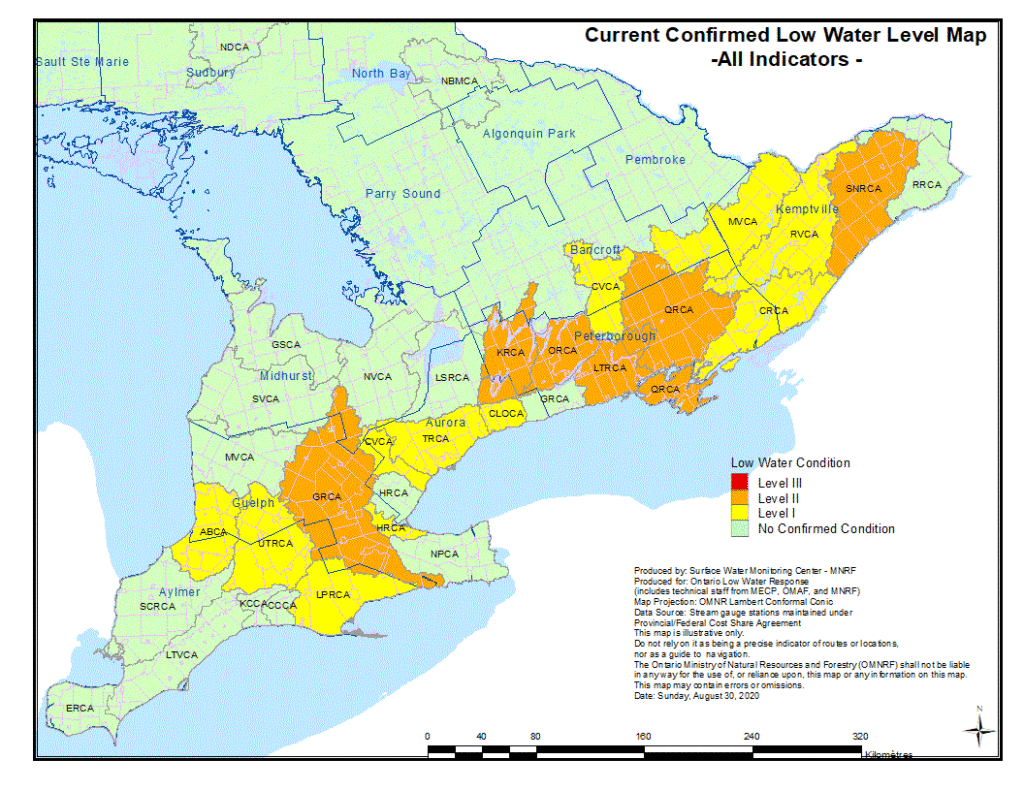
- Agriculture and Agri-Food Canada reports above-average precipitation in August across most of the region, which resulted in good regrowth of hay and pastures. However, the Ontario Ministry of Natural Resources and Forestry reports that many areas are still experiencing low surface water levels due to dry conditions from earlier this year.
- This region is in the fall rest period for alfalfa. Producers who need the feed and cut between now and the first killing frost should anticipate an increased risk of winterkill. Best practice in this scenario is to have a plan to terminate the crop and rotate out of alfalfa, if necessary, in the spring.
- Reports suggest many acres were seeded to an annual forage crop after winter wheat harvest.
Northeast
- According to Agriculture and Agri-Food Canada, most of the region received above-average levels of precipitation during August, except for Temiskaming and Cochrane districts. Regrowth of hay and pasture was good.
- This region is in the fall rest period for alfalfa. Producers who need the feed and cut between now and the first killing frost should anticipate an increased risk of winterkill. Best practice in this scenario is to have a plan to terminate the crop and rotate out of alfalfa, if necessary, in the spring.
Northwest
- According to Agriculture and Agri-Food Canada, most of the region received average or above-average rainfall in August. Regrowth of hay and pasture was good.
- This region is in the fall rest period for alfalfa. Producers who need the feed and cut between now and the first killing frost should anticipate an increased risk of winterkill. Best practice in this scenario is to have a plan to terminate the crop and rotate out of alfalfa, if necessary, in the spring.