


I recently read an article on farm labour shortage indicating that “the domestic labour pool is expected to drop largely due to an older-than-average workforce and few young entrants.” I have also heard conversations like, young people don’t want to work, or they don’t know how to work. Yet, I have also met some very motivated young people who are looking to start sheep farming and are finding the task of learning everything needed, financing an operation, etc. daunting. This is not a new issue and is governed by a complex matrix of factors. I would like to bring up one factor that I haven’t heard talked about often in the sheep industry and that is workplace culture.
I know farmers who think that they should be able to hire someone who understands:
- It is a privilege to work on the farm
- that farming is hard and unpredictable
- how to do basic farming tasks
- that as the boss with lots of experience I know how to do the job efficiently
- that working hours are not over until the job is done
- that wages can’t be high
However, young people have been leaving the farm for decades. It is possible that to attract future sheep farmers, whether it be family members or hiring staff, that one factor that needs improvement is the workplace culture of the farm so it is more attractive to a new generation.
Tony Plunkett and Sarah Barr gave a presentation at the 2019 New Zealand Beef and Lamb Farmsmart conference on their view of workplace culture and how farms need to take a look at how they are managing the people resource in the farm business. The following is largely a summary of ideas from their presentation at Beef and Lamb Farmsmart.
What is workplace culture?
Workplace culture is often described as the values and attitudes of the workplace. But another way to phrase it is how you do things and how you treat people. Your workplace culture matters because it directly affects labour on your farm. Good culture has the following characteristics:
- Clearly defined business strategy and standard operating procedures
- High trust and confidence
- Employee willingness, accountability and collaboration
- Employee retention
- Productive and efficient
- Pride and ownership among employees
If the people working on your farm don’t feel pride, ownership and have confidence that they are doing a good job, it will be more difficult for them to be productive and they will likely be looking for a different job.
How can you create a good culture?
Abraham Maslow developed a theory of motivation based on a hierarchy of needs. The idea is that the physiological, safety, belonging and esteem needs listed in the figure below must be satisfied for a person to be highly motivated.

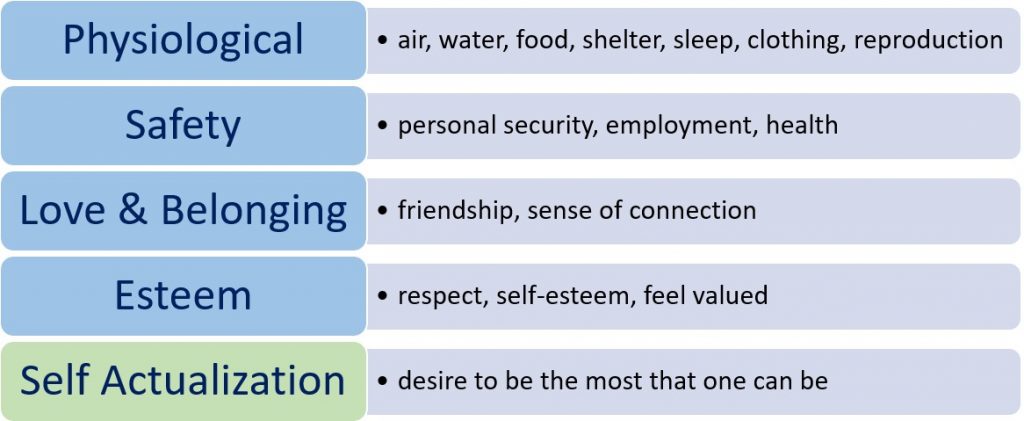
This means that if someone is worried about having enough to eat or whether they are going to get hurt on the job or don’t feel respected or appreciated, or can never do the job to your satisfaction, they are not able to be as motivated as someone without those concerns.
In order to build your culture, you must be your culture. A clear definition of the values and behaviours that equal success on your farm is required. Then you as the leader must lead by example. So, if I say that it is important to put something back, then I must always put it back as well. Otherwise I send the message that it isn’t important. Good structures and processes must be in place to ensure employees have the opportunity to be successful and feel like they belong in your business.
It takes self awareness and honesty to admit what your behaviours might doing to your staff and culture. Yelling, bullying, poor communication, absenteeism are all indications that the culture needs to be improved. Some considerations for improving workplace culture are:
- Be accountable – your staff will be as accountable or reliable as you are.
- Practice coaching not telling – helping them see what needs to be done.
- Grow and develop employees – offer more than just a job – the best workers are those who want to grow out of the job and go elsewhere
- Realistic goals, don’t sweat the small stuff – 90% is a good job
- Teach and expect good planning
- Work sensible hours – improve time management and organization
- Offer competitive pay
Maybe instead of saying “I should be able to hire someone who”, the idea should be reframed as “People will be interested in working here because”:
- My operation is a leading sheep operation using proven production systems to produce prime market lambs
- Employees are given opportunities to develop new skills to meet their goals as well as the farm goals
- Employees are part of a successful team with meaningful work
- Employee wellbeing is important, and leadership works to improve physical, social, emotional and financial health
This mindset change of putting value on the employee point of view as well as the farm job can make it easier to see new solutions. For example, although traditionally farmers have worked until the job is done, in many situations, the job can be changed so it is done in a better timeframe.
In conclusion, Tony and Sarah believe that a lot can be done to improve the reputation of farm work by changing how we view farm labour. Everyone working on the farm can feel valued and respected by actively building a workplace culture on your farm.
References:
Karen Briere, FarmOntario 2019. Ontario expected to have largest farm labour shortage. Accessed Nov 19, 2019. https://farmtario.com/news/ontario-expected-to-have-largest-farm-labour-shortage/
NZ Beef and Lamb FarmSmart 2019 Presentation: Tony Plunkett & Sarah Barr – ‘Drafting for passion, finishing prime’. Accessed at https://www.youtube.com/watch?v=_XX_THA-PR0 Nov 19, 2019.