Save the date! Forage Focus 2019 will be held December 5th 9:30 am – 3:30 pm EST at the Stratford Rotary Complex. Registration will open soon. Ontario Forage Council is looking for remote location hosts to receive the live stream in northern and eastern Ontario. If interested in hosting, contact Patricia Ellingwood at 1-877-892-8663.
The Ontario Hay Listings website is a free classifieds database for producers looking to buy or sell hay and straw.
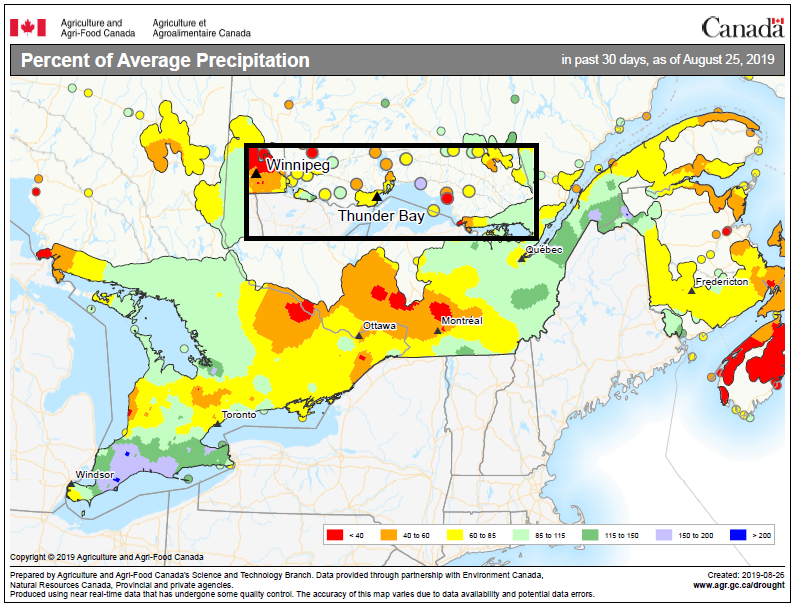
Figure 1. Percent of average precipitation received in the 30 days prior to August 25, 2019
Southwestern
According to AAFC, rainfall during August varied widely across the region. The counties on the north shore of Lake Erie, along with Lambton, Middlesex, Oxford, Brant, and Hamilton received 115% – 200% of average precipitation for the month. In these counties, dairy third cut and other second cut hay yields have been good. Quality may be an issue in dry hay due to frequent rain events.
AAFC’s precipitation report indicates that areas of Huron, Perth, Wellington, Waterloo, Dufferin, Simcoe, Peel, the western part of Essex, and the southern parts of Bruce and Grey counties had below-average rainfall in August. In these areas, dairy third cut and other second cut hay yields are below average.
The fall rest period for alfalfa started August 25 in Dufferin and August 30 in much of western Ontario. Start dates are in early September for southern Ontario. Avoid cutting alfalfa during the six weeks following the start date for the fall rest period to allow alfalfa to harden off and improve its winter survival.
While planting earlier results in higher yields, spring cereals can be sown up to mid-September to provide extra forage this fall. Fall cereals can be established as late as after silage corn harvest for extra forage next spring.
Pasture growth and yield is directly affected by rainfall. Areas with average or above average rainfall have seen slow to moderate growth, while in drier areas the summer slump has caused grass to go dormant.
Central and
Eastern
According to AAFC, most of the region received below average precipitation during August. Parts of Durham, Northumberland, and Peterborough counties had average rainfall. In the region, Leeds & Grenville and part of Renfrew are the driest, receiving less than 60% of average precipitation for the month.
Potato leafhopper pressure is heavy this year. These small, wedge-shaped, lime green insects can stunt alfalfa growth and reduce winter survival. Stunting occurs before symptoms are visible. Producers should scout fields every 5-7 days. Scouting information can be found on pages 341 and 342 of OMAFRAPub. 811: Agronomy Guide for Field Crops.
The fall rest period for alfalfa started August 25 in areas north of Highway 7 through central Ontario. The rest of central ON and the far east have a start date of August 30. Along the north shore of Lake Ontario, the fall rest period starts September 4. Avoid cutting alfalfa during the six weeks following the start date for the fall rest period to allow alfalfa to harden off and improve its winter survival.
While planting earlier results in higher yields, spring cereals can be sown up to early September to provide extra forage this fall. Fall cereals can be established as late as after silage corn harvest for extra forage next spring.
Pasture growth and yield is directly affected by rainfall. Dry conditions have extended the summer slump and grass in many pastures in the region is dormant. Growth will resume when cooler, wetter weather returns.
Northeastern
AAFC’s precipitation report indicates that Algoma, Cochrane, Timiskaming, the western end of Manitoulin, and parts of Nipissing have received below-average rainfall for August. Average precipitation was received across the rest of the region.
The fall rest period for alfalfa started August 10 in Cochrane and began later further south – August 25 in parts of Parry Sound and August 30 on Manitoulin. The fall rest period for birdsfoot trefoil starts ten days earlier than alfalfa. Avoid cutting legumes during the six weeks following the start date for the fall rest period to allow plants to harden off and improve winter survival.
Pasture growth and yield is directly affected by rainfall. Dry conditions have extended the summer slump and grass in many pastures in the region is dormant.
Northwestern
According to AAFC, rainfall during August varied across the region, but generally was average or below-average.
Reports suggest many producers are still planning to take a second or (dairy) third cut, weather and yield permitting.
The fall rest period for alfalfa started August 10 in Kenora and began later further south – August 15 in Rainy River and parts of Thunder Bay. The fall rest period for birdsfoot trefoil starts ten days earlier than alfalfa. Avoid cutting legumes during the six weeks following the start date for the fall rest period to allow plants to harden off and improve winter survival.
Figure 2. Average start dates for the fall rest period for alfalfa. The fall rest period begins six weeks before the average date of the first killing frost