

Haemonchus contortus, also known as the “Barber’s Pole Worm,” is a deadly nematode parasite that lives in grass during its infectious juvenile life stage, and as a result, is eaten by sheep as they are grazing. The worms travel along with the ingested food and will bury within the stomach wall of the abomasum of the animal, where it will spend the next major life stage as an adult. Mature female worms have the capacity to release 5-10 thousand eggs per day, which are then released from the abomasum and make their way into the feces. While in the feces, the eggs will hatch and become the infectious juvenile life stage that is found in pastures.

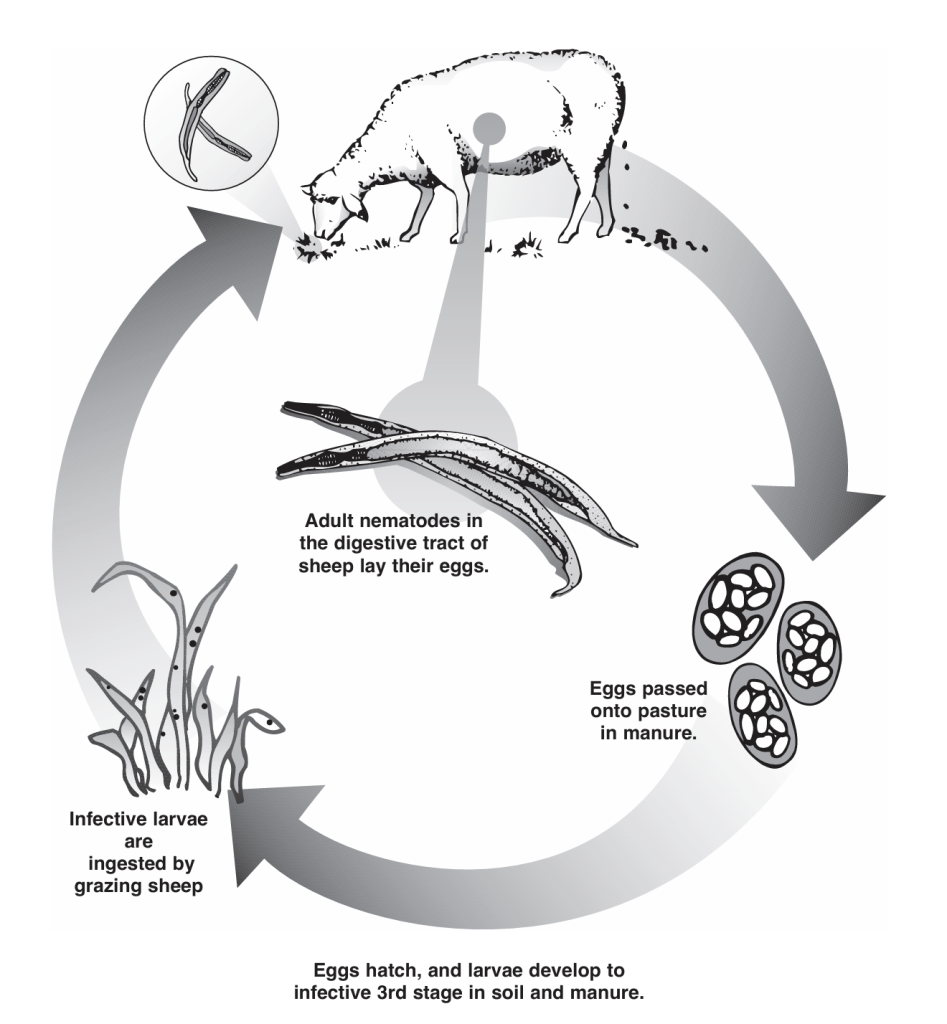
This blood-sucking parasite conducts its lifecycle to coincide with climate patterns so that it has a high level of infectivity. Typically, the juvenile life stage of the parasite is left to over-winter outside of the animal within the pasture. This life stage is heavily dependent on environmental conditions and is not as infectious. On the other hand, the adult parasite resides within the animal over the winter and will remain dormant until the spring, when it will complete development just in time for lambing season. This provides the most dangerous situation because these adult parasites will begin to shed a high load of eggs starting in early spring, and by late summer, will cause severe pasture contamination.
Disease outbreaks usually occur within the timeframe from mid-July to August, and depend heavily on environmental factors such as air temperature and moisture. As a result, outbreaks tend to occur quite early if the summer is hot and wet, and later in cool summers. But when weather conditions are hot and dry like this season, the juvenile life stage of the parasite is not able to live on the pasture. Thus, it is possible that the weather patterns this year may help to reduce pasture contamination in spring 2017, and may help control parasite load of the animals next year. However, if the weather patterns change and we experience wet conditions along with this heat and humidity, the parasite may actually thrive and become quite problematic. Only time will tell, be on the lookout!
So what are some ways that you can minimize the effects of this nasty parasite? Firstly, do NOT drench all animals immediately – this parasite is becoming highly resistant to anti-helminthic treatment and this treatment option will only make this problem worse. The best management tool is to sort individuals based on the following factors and treating ONLY the individuals who show the strongest signs of serious infection:
- FAMACHA Score your sheep – using a scorecard to determine if the individual is anemic, which is the main indication of serious infection and will help when sorting off infected individuals
- Body Condition Score your sheep – infected individuals tend to have lower body condition scores and this can help when sorting off infected individuals
- Fecal Egg Counts for the flock – this is a reliable way to determine the parasite load of the flock and will indicate whether the flock should be treated or not!
For more information read the Handbook for the Control of Internal Parasites of Sheep and Goats.
References:
- https://www.ontariosheep.org/media/5asjef20/parasite-handbook_april_2019-updated-w-cover-compressed-for-online.pdf
- “The Bloodthirsty Haemonchus contortus and what you can do about it”. Caroline von Waldburg, 2016.
- Diagram from: Whittier, D.W., Zajac, A., Umberger, S.H. (2009) Control of internal parasites in sheep. Virginia Tech. Figure 1, Page 2.
.